

The internet is full of protocols. The gut-healing protocol. The thyroid protocol. The detox protocol. The anti-inflammatory protocol. Each one is a fixed list of steps and supplements that worked for someone, packaged up and sold as the answer. You follow it carefully, and it either does nothing, or helps briefly and then stalls, and you are left assuming you did it wrong.
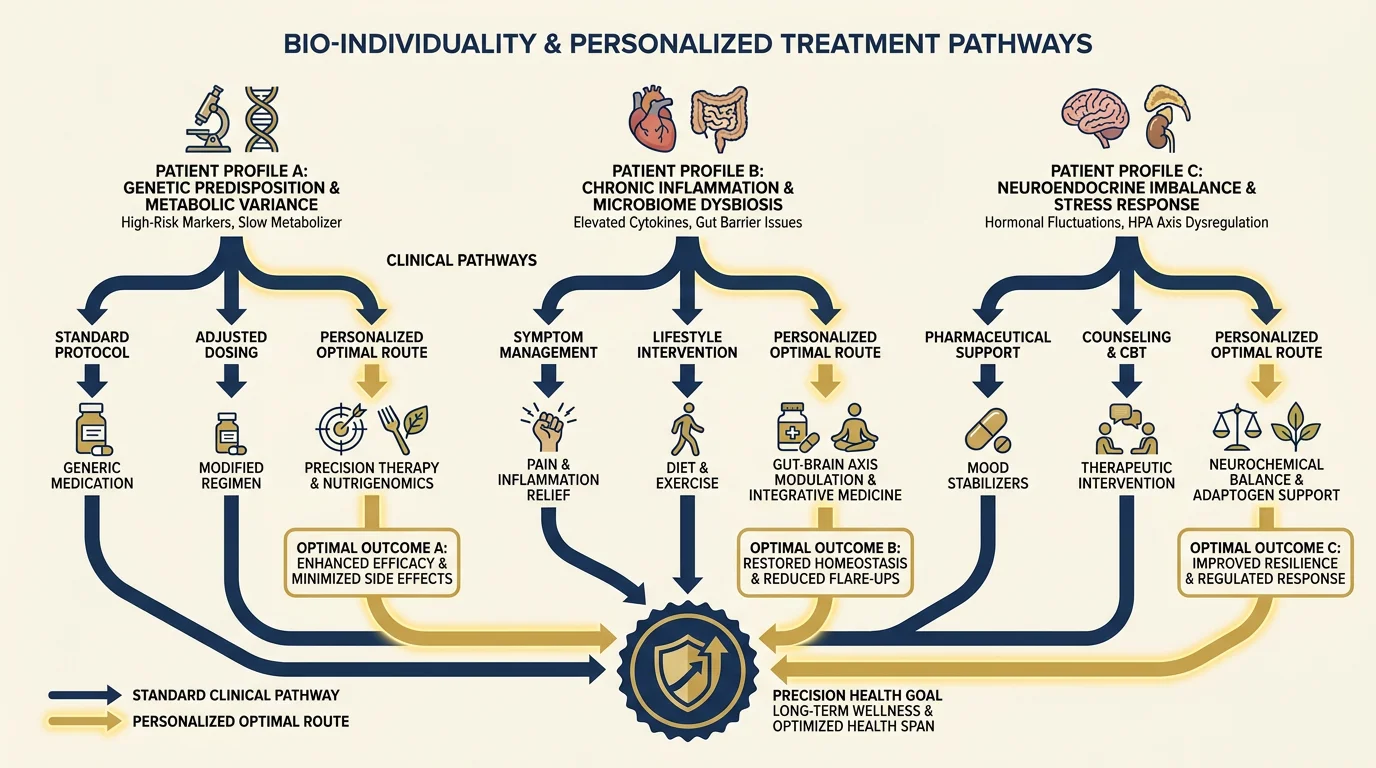
You probably did not do it wrong. The protocol failed for a structural reason: it was built for a generic body, not yours, and it was fixed when your situation needed something that adapts. After more than a decade in practice, I can tell you that the difference between a protocol and a result is not the quality of the steps. It is whether the plan is matched to your actual data and adjusted as your body responds.
A protocol is a guess without your data
A protocol you find online or buy off a shelf was designed without knowing anything about you. It does not know whether your gut is inflamed, whether you absorb nutrients, what is driving your symptoms, or which systems are stable and which are not. It is, by definition, a guess applied to an average person who does not exist.
This matters because the same symptom can have completely different causes. Five people with identical gut symptoms can need five different treatments, one has an overgrowth, one a parasite, one poor bile flow, one a leaky barrier, one depleted flora 16. A single gut protocol helps the one it happens to match and does nothing for the other four. Without data, you do not know which one you are, so you are running someone else’s answer to a question you have not actually asked of your own body. The fix is to map before you treat, to replace the guess with a picture of what is actually happening inside you.
A fixed plan cannot follow a moving body
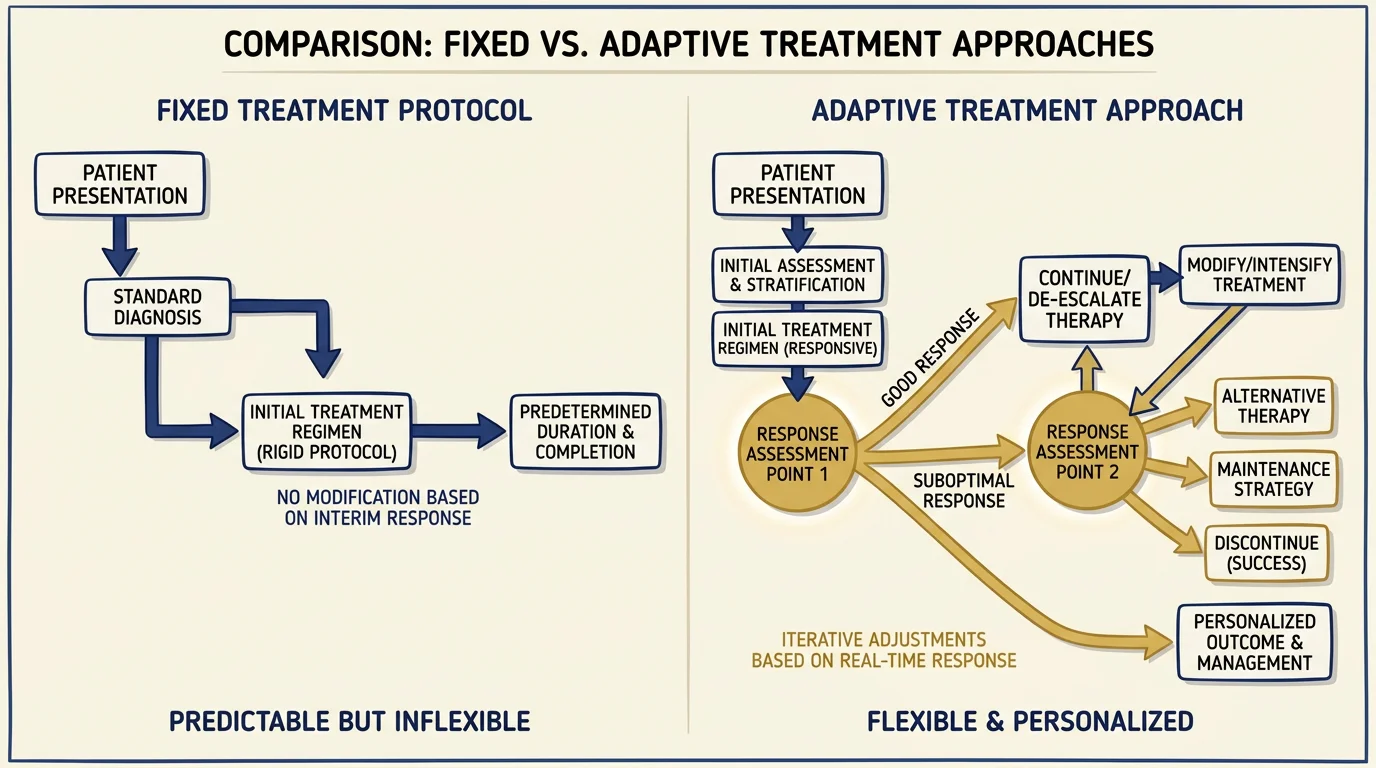
The second reason protocols fail is that they are static, and recovery is not. A body changes as you treat it. Markers that were abnormal normalise, new things surface, one system improving increases demand on another. A fixed protocol cannot respond to any of that. It tells you to take the same things in week twelve that you took in week one, regardless of what your body has done in between.
Real recovery needs a feedback loop: test, act, retest, adjust. You intervene based on data, you measure what changed, and you adjust the plan accordingly 2. This is also how you tell a genuine setback from a normal part of healing, because some worsening, like a temporary die-off reaction, is expected and some is a signal to change course, and only data tells you which. A protocol has no feedback loop. It cannot tell the difference, so it either pushes on through something it should respond to, or abandons something that was actually working.
Why sequence beats the stack
Even a well-chosen set of interventions fails if they are applied in the wrong order, and most protocols ignore order entirely, presenting their steps as a menu rather than a sequence. But the body has a hierarchy. Some systems must be stable before others can respond. Support hormones while the gut is inflamed and it will not hold. Clear pathogens before repairing the barrier and you flood the body with inflammatory debris. Add a nutrient the gut cannot absorb and you have wasted it 35.
The order that works is consistent: stabilise the system, repair the gut, restore the biochemistry, then optimise the downstream hormones and performance 4. A protocol that lists good interventions in no particular order, or in the wrong one, will underperform a smaller set applied in the right sequence. Sequence is not a refinement of the plan. It is the plan.
What works instead
The alternative to a protocol is not a better protocol. It is a different approach entirely: a precision process. Map your systems with real data so you know what you are treating. Build a plan matched to that data, not to an average. Work in the right sequence, foundations first. Then run the feedback loop, retest and adjust as your body responds. It is less convenient than a list you can buy, because it requires knowing your own data and adapting over time. But it is the difference between following someone else’s guess and treating the body you actually have.
Where to start
The precision process, mapping, sequencing and the feedback loop, is the core method in my book.
For a plan built and adjusted around your own data, I take a small number of telehealth patients each year, across Australia and worldwide.
FAQ
Why didn't the protocol I followed work?
Aren't some protocols evidence-based?
What's the difference between a protocol and what you do?
Why does the order matter so much?
Do I need testing, or can I just follow a good plan?
References
- 1 Pimentel M, Saad RJ, Long MD, Rao SSC. ACG Clinical Guideline: Small Intestinal Bacterial Overgrowth. Am J Gastroenterol. 2020;115(2):165-178. view source
- 2 McEwen BS. Stress, adaptation, and disease: allostasis and allostatic overload. Ann N Y Acad Sci. 1998;840:33-44. view source
- 3 Vighi G, Marcucci F, Sensi L, et al. Allergy and the gastrointestinal system. Clin Exp Immunol. 2008;153(S1):3-6. view source
- 4 Fasano A. Zonulin and its regulation of intestinal barrier function. Physiol Rev. 2011;91(1):151-175. view source
- 5 Holotranscobalamin (active B12) and methylmalonic acid as functional markers of B12 status; total serum B12 is relatively insensitive (holotranscobalamin diagnostic literature). view source
- 6 Liew SC, Gupta ED. MTHFR C677T polymorphism: epidemiology, metabolism and the associated diseases. Eur J Med Genet. 2015;58(1):1-10. view source