
If you have gut problems that will not resolve, you already know the basics. You have probably removed gluten. Maybe dairy. Maybe FODMAPs. You have tried probiotics, digestive enzymes, bone broth, fermented foods. Some of it helped for a while. Then it stopped, or something new appeared in its place.
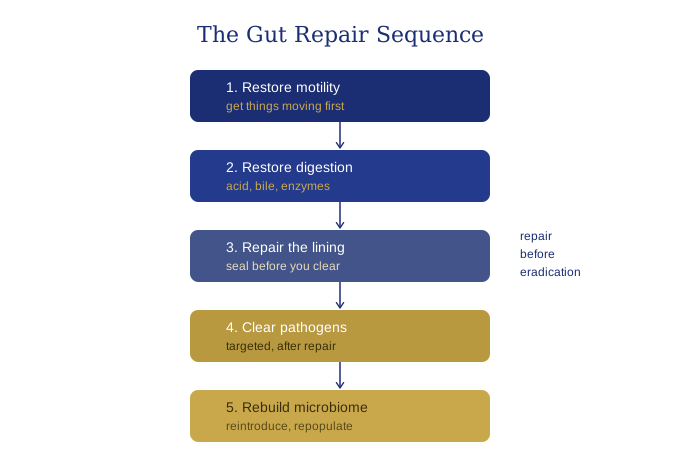
You are not imagining it, and you are not doing it wrong. The interventions are usually fine. What goes wrong is the order. Gut restoration is not a single fix. It is a sequenced protocol with five phases, and the order matters as much as the interventions themselves. Get the order wrong and you do not just slow progress. You can set the patient back, sometimes badly.
Why the gut comes first
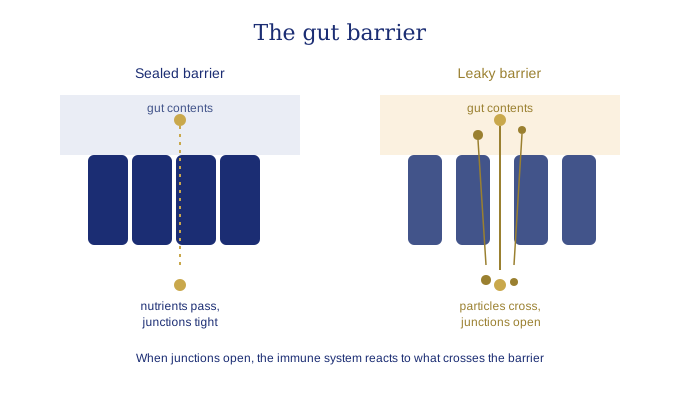
Before the sequence itself, it is worth understanding why the gut sits so high in the order of treatment. Between seventy and eighty per cent of the immune system lives in the tissue around the gut 1. Most of the body’s serotonin is produced there 2. The gut wall is where nutrients are absorbed, and it is one cell thick, a remarkably thin barrier between the outside world and your bloodstream. When that barrier is intact, it lets nutrients through and keeps everything else out. When it is inflamed and leaking, undigested food particles and bacterial fragments cross into the blood, the immune system mounts a response, and a cascade of downstream problems follows, from autoimmunity to skin issues to brain fog 34.
This is why the gut is the second level of the Healing Hierarchy, addressed right after the body is stabilised out of crisis. You cannot absorb the nutrients to repair anything else while the gut is compromised, and you cannot calm a reactive immune system while it is being provoked daily from the gut. Fix the gatekeeper and the downstream systems begin to settle.
The five phases
Phase one: motility
Before anything else, waste has to be moving. If you are constipated, not passing a well-formed stool at least once a day, nothing else will work properly. Toxins that should leave the body get reabsorbed. Die-off from any later antimicrobial treatment has nowhere to go and recirculates. The gut environment turns stagnant, and stagnation breeds further dysbiosis.
The tools here are unglamorous and effective: magnesium, adequate hydration, fibre from whole food sources, and in some cases targeted motility support. Motility is not the exciting part of gut work, but it is non-negotiable. If the drains are blocked, you do not start running water.
Phase two: digestive support
Once things are moving, the focus shifts to actually breaking down and absorbing food. That means stomach acid, bile flow, and pancreatic enzymes. Low stomach acid, far more common than excess and especially in people over forty, means proteins are not broken down and minerals are not absorbed, and partially digested food sits and ferments. Sluggish bile means fats and the fat-soluble vitamins A, D, E and K are missed, and the small intestine is not being swept clean, because bile is itself a natural antimicrobial.
This is one of the main reasons SIBO recurs after treatment 5. The overgrowth gets cleared, but if bile flow and motility were never restored, the conditions that allowed the overgrowth simply return. Digestive enzymes, bile salts, and where appropriate betaine HCl to support stomach acid are the tools at this phase.
Phase three: gut lining repair
Now the barrier itself is rebuilt, sealing the tight junctions that have been letting particles leak through. L-glutamine is the primary fuel for the cells lining the gut wall. Zinc carnosine supports the mucosal lining and calms inflammation in it. Collagen and bone broth provide the building blocks for tissue repair.
This phase has to come before aggressive antimicrobial treatment, and the reason is critical. If you start killing pathogens before the lining has begun to repair, the inflammatory debris from the die-off passes straight through the still-permeable barrier and triggers a body-wide immune response. The patient feels markedly worse, not better. This is the single most common reason people crash on a gut protocol. Repair before eradication. Always.
Phase four: pathogen eradication
Only once motility is established, digestion is supported, and lining repair is underway do I begin targeted antimicrobial treatment, guided by what the stool test actually revealed. Bacterial overgrowth, parasites, fungal dominance, and methane-producing organisms each need a different approach, which is why I use targeted herbal blends rather than broad-spectrum guessing. Sensitised patients need precision, not a scattergun.
Specific spore-based or saccharomyces-based probiotics are used alongside the antimicrobials to support rebalancing, while traditional multi-strain probiotics are generally held until the clearing phase is complete. The goal is not to sterilise the gut. It is to shift the balance, reduce the pathogenic load, and create space for beneficial organisms to return.
Phase five: microbiome rebuilding
With the pathogens cleared, the focus turns to rebuilding microbial diversity, through multi-strain probiotics, fermented foods, and prebiotic fibre that feeds the beneficial bacteria. This is also where careful food reintroduction begins, testing what the body can now tolerate that it could not before. The key insight here is that the reactivity which drove those food intolerances was usually a consequence of the leaky gut, not a permanent feature of your biology 6. Once the barrier is sealed and the ecosystem rebalanced, many foods that previously triggered symptoms can be reintroduced without a reaction.
Why the order matters
Every phase exists because of the one before it. Skip motility and the die-off has nowhere to go. Start eradication before repair and the debris passes through a barrier that is still open. Add probiotics before clearing pathogens and the good bacteria cannot establish, because the pathogens still hold the territory. Rebuild the microbiome before fixing digestion and the new bacteria starve in an environment that cannot support them.
These are the exact mistakes I see in people who arrive after gut protocols have failed. Antimicrobials with no motility support, so the die-off recirculated and the overgrowth returned within months. Probiotics and gut-healing supplements while undiagnosed parasites were still disrupting the ecosystem. A repair protocol that never assessed stomach acid or bile, so nothing was being absorbed to rebuild with. The treatments were not wrong. The sequence was.
What it looks like in practice
Sarah’s case shows the full sequence. She arrived with an autoimmune diagnosis and a decade of escalating symptoms. Her stool test showed a wide-open barrier (zonulin 185, normal below 107), inflammation five times the threshold (calprotectin 285, normal below 50), a depleted gut immune defence (secretory IgA 142, optimal 510 to 2040), and severe overgrowth of Klebsiella and Citrobacter. Her blood showed systemic inflammation (CRP 8.2, optimal below 1.0).
We did not aggressively kill everything first. We supported motility and digestion, then ran four weeks of lining repair before introducing targeted herbal antimicrobials for the overgrowth, with high-dose probiotics to shift the balance. A whole-food reset ran alongside, and at week eight slow reintroduction identified gluten and dairy as her primary triggers, which were removed long-term. Six months on, her zonulin was 68, calprotectin 22, CRP 0.6, and secretory IgA back up to 890. The autoimmune flares stopped and her digestion became predictable for the first time in a decade. The interventions were not exotic. The order was what made them work.
FAQ
Is leaky gut a real diagnosis?
Why does my SIBO keep coming back?
Can I just take probiotics to fix my gut?
Will I have to stay on a restricted diet forever?
How long does gut repair take?
References
- 1 Vighi G, Marcucci F, Sensi L, et al. Allergy and the gastrointestinal system. Clin Exp Immunol. 2008;153(S1):3-6. view source
- 2 Yano JM, Yu K, Donaldson GP, et al. Indigenous bacteria from the gut microbiota regulate host serotonin biosynthesis. Cell. 2015;161(2):264-276. view source
- 3 Fasano A. Zonulin and its regulation of intestinal barrier function. Physiol Rev. 2011;91(1):151-175. view source
- 4 Fasano A. Leaky gut and autoimmune diseases. Clin Rev Allergy Immunol. 2012;42(1):71-78. view source
- 5 Pimentel M, Saad RJ, Long MD, Rao SSC. ACG Clinical Guideline: Small Intestinal Bacterial Overgrowth. Am J Gastroenterol. 2020;115(2):165-178. view source
- 6 McEwen BS. Stress, adaptation, and disease: allostasis and allostatic overload. Ann N Y Acad Sci. 1998;840:33-44. view source