
If your gut has been a problem for years, you have probably been told one of two things. Either every test came back clear and you were left with a label like IBS and a shrug, or you were handed a long list of things to remove and supplements to add that helped for a while and then stopped. Bloating, alternating constipation and diarrhoea, reflux, cramping, food reactions that seem to multiply rather than settle.
If your gut has been a problem for years, you have probably been told one of two things. Either every test came back clear and you were left with a label like IBS and a shrug, or you were handed a long list of things to remove and supplements to add that helped for a while and then stopped. Bloating, alternating constipation and diarrhoea, reflux, cramping, food reactions that seem to multiply rather than settle.
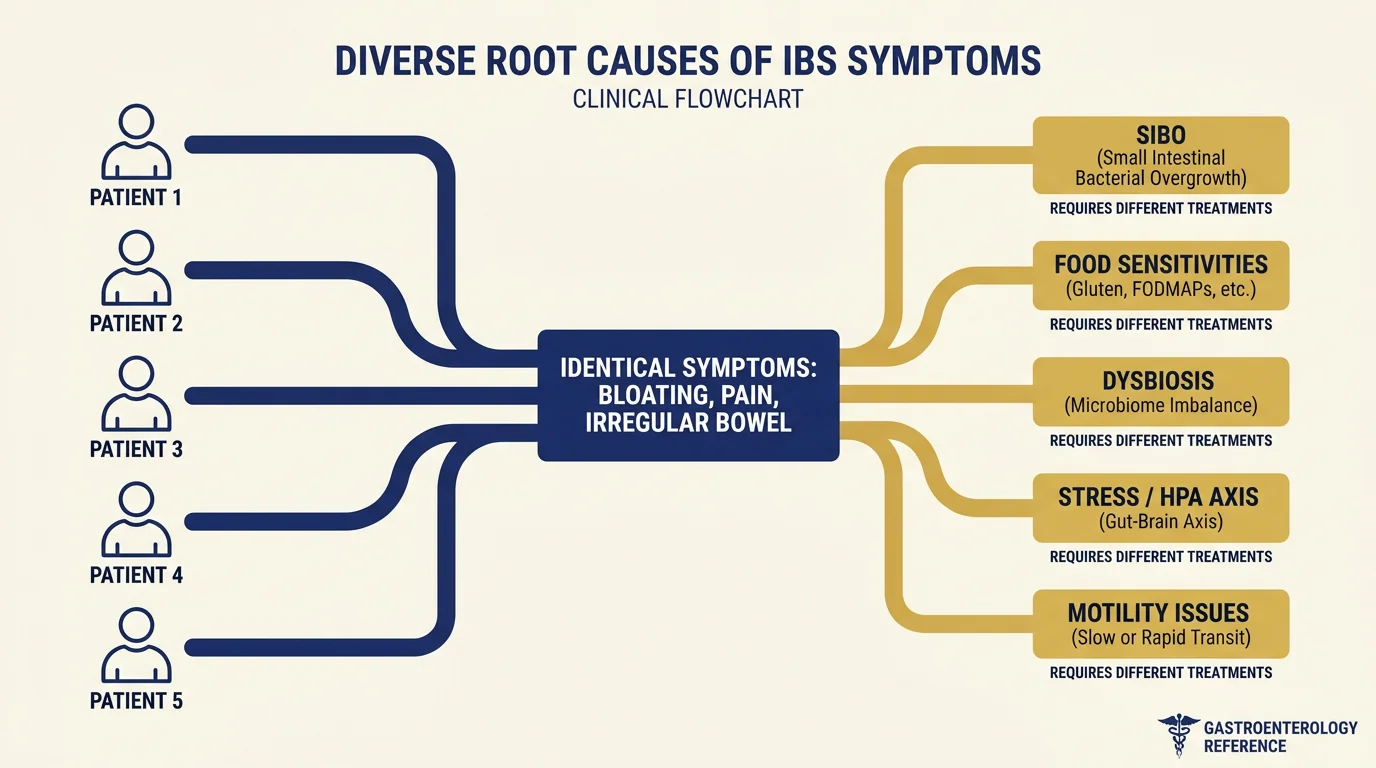
Here is the thing most people are never told. The same set of gut symptoms can have completely different causes, and the cause determines the fix. Five people can walk in with identical IBS symptoms and need five different treatment plans. Without knowing which one you are, any protocol is a guess, and guessing in an irritated gut often makes things worse.
Why the same symptoms have different causes
Take bloating, gas and irregular bowel habits, the classic IBS picture. One person has methane-dominant SIBO driving constipation. Another has a parasite. A third has poor fat digestion from sluggish bile and a lazy gallbladder. A fourth has severe food reactions driven by a leaky gut barrier. A fifth has bacterial dysbiosis with depleted beneficial flora. Same symptoms. Five completely different drivers. Five different treatment plans.
This is why symptom-based gut treatment so often fails. A probiotic helps the person with depleted flora and does nothing for the person with a parasite. A low-FODMAP diet quiets the SIBO case and starves the person who needed to feed their microbiome. The advice was not wrong. It was aimed at the wrong driver. The only way to know which one you are is to look properly, which is what an advanced stool test is for.
The gut is the gatekeeper
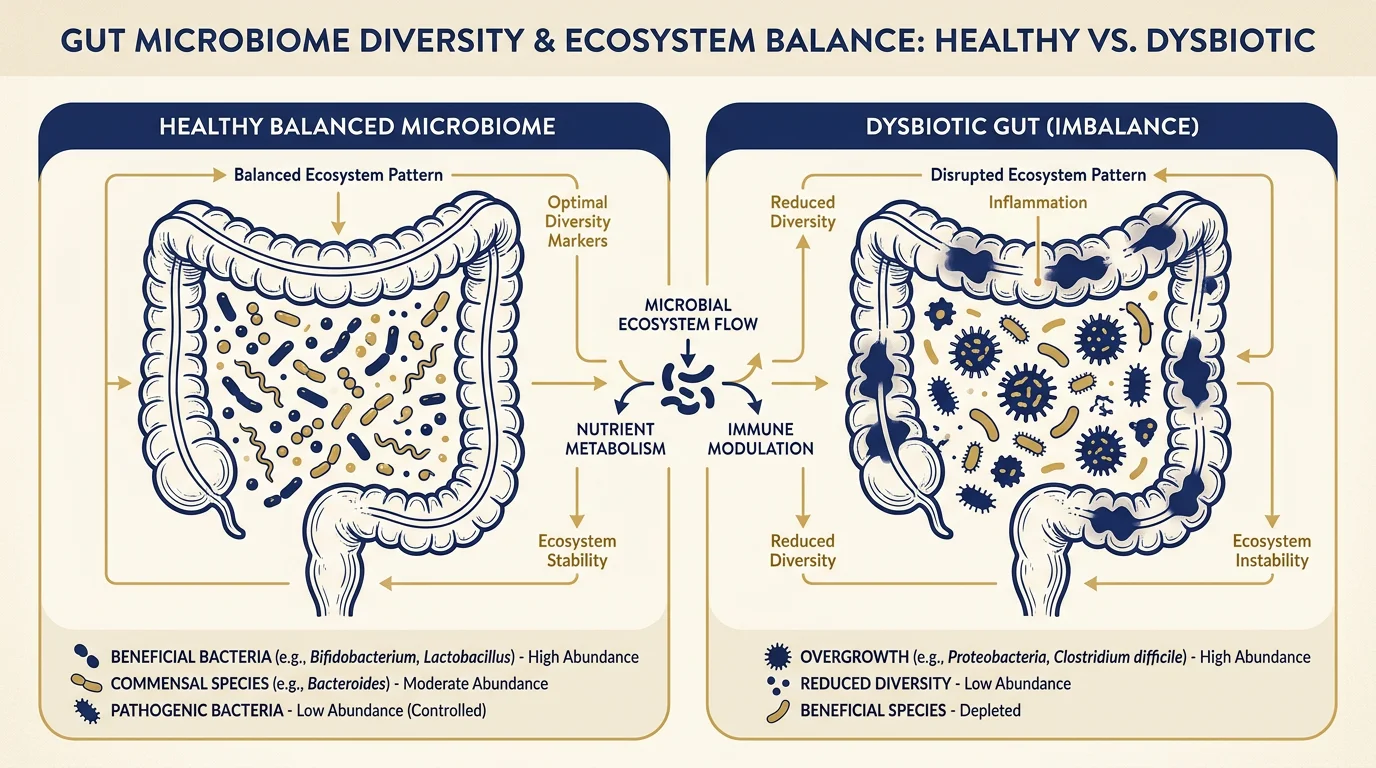
The gut matters more than almost any other system because of what lives there. Between seventy and eighty per cent of your immune system sits in the tissue around the gut.1 Most of your serotonin is made there.2 The gut wall is one cell thick, a remarkably thin barrier between everything you eat and your bloodstream. When it is intact it lets nutrients through and keeps everything else out. When it is inflamed and leaking, food particles and bacterial fragments cross into the blood, the immune system reacts,3 a process linked to intestinal permeability,6 and the consequences show up far from the gut: skin problems, joint pain, brain fog, autoimmune flares, mood changes.4
This is why so many problems that do not look like gut problems actually begin there. And it is why, in my framework, the gut is the second thing addressed after the body is stabilised, because you cannot absorb the nutrients to repair anything else, or calm an overactive immune system, while the gut is compromised.
Healing the gut is a sequence, not a supplement
The biggest mistake in gut treatment is doing the right things in the wrong order. Gut repair has five phases and the order is not optional.
First, motility, because if waste is not moving, nothing else works and any later die-off has nowhere to go. Second, digestion, restoring stomach acid, bile and enzymes5 so food is actually broken down and absorbed, and so the small intestine is swept clean (this is why SIBO recurs when bile flow is never fixed5). Third, lining repair, sealing the barrier before any aggressive pathogen treatment, because killing pathogens through a leaky wall floods the body with inflammatory debris and makes people markedly worse. Fourth, pathogen clearance, targeted to what the testing actually found. Fifth, rebuilding the microbiome and carefully reintroducing foods.
Get this order wrong and you set people back. Antimicrobials with no motility support, so the die-off recirculates. Probiotics while pathogens still hold the territory. A repair protocol that never checked whether anything was being absorbed. The full sequence is laid out on the Gut Repair Sequence page.
A real case
Sarah arrived with an autoimmune diagnosis and a decade of escalating symptoms that previous practitioners had been trying to suppress with medication. Her advanced stool test showed why suppression was never going to work. Her zonulin was 185 against a normal below 107, the barrier wide open. Her calprotectin was 285 against a normal below 50, gut inflammation five times the healthy threshold. Her secretory IgA, the gut’s own immune defence, was 142 against an optimal 510 to 2040, almost offline. And she had severe overgrowth of two inflammatory bacteria, Klebsiella and Citrobacter. Her blood showed body-wide inflammation, with CRP at 8.2 against an optimal below 1.0.
Her immune system was not malfunctioning. It was responding correctly to a gut that had been sending distress signals for over a decade. We did not aggressively kill everything first. We supported motility and digestion, ran lining repair before introducing targeted antimicrobials, used a whole-food reset alongside, and at week eight reintroduced foods slowly, which identified gluten and dairy as her triggers. Six months on, her zonulin was 68, calprotectin 22, CRP 0.6, and secretory IgA back to 890. The autoimmune flares stopped and her digestion became predictable for the first time in a decade. The interventions were not exotic. The order was what made them work.
Where to start
The full gut sequence, the testing, and how it fits the wider framework are in my book. For complex gut cases, I take a small number of telehealth patients each year, across Australia and worldwide.
FAQ
Is leaky gut a real thing?
Why does my SIBO keep coming back?
Can I just take a probiotic to fix my gut?
Will I have to avoid these foods forever?
Do I need a stool test, or can I just follow a gut protocol?
References
- 1 Vighi G, Marcucci F, Sensi L, et al. Allergy and the gastrointestinal system. Clin Exp Immunol. 2008;153(S1):3-6. view source
- 2 Yano JM, Yu K, Donaldson GP, et al. Indigenous bacteria from the gut microbiota regulate host serotonin biosynthesis. Cell. 2015;161(2):264-276. view source
- 3 Fasano A. Leaky gut and autoimmune diseases. Clin Rev Allergy Immunol. 2012;42(1):71-78. view source
- 4 Vojdani A, Kharrazian D, Mukherjee PS. The prevalence of antibodies against wheat and milk proteins in blood donors and their contribution to neuroimmune reactivities. Nutrients. 2014;6(1):15-36. view source
- 5 Pimentel M, Saad RJ, Long MD, Rao SSC. ACG Clinical Guideline: Small Intestinal Bacterial Overgrowth. Am J Gastroenterol. 2020;115(2):165-178. view source
- 6 Fasano A. Zonulin and its regulation of intestinal barrier function. Physiol Rev. 2011;91(1):151-175. view source