
You were diagnosed with SIBO, small intestinal bacterial overgrowth. You did the treatment, maybe an antibiotic or herbal antimicrobials, and you felt better for a few weeks or months. Then the bloating, the distension, the reaction to almost everything you eat, all came back. Perhaps you have been around this loop two or three times now, and each round works a little less well.
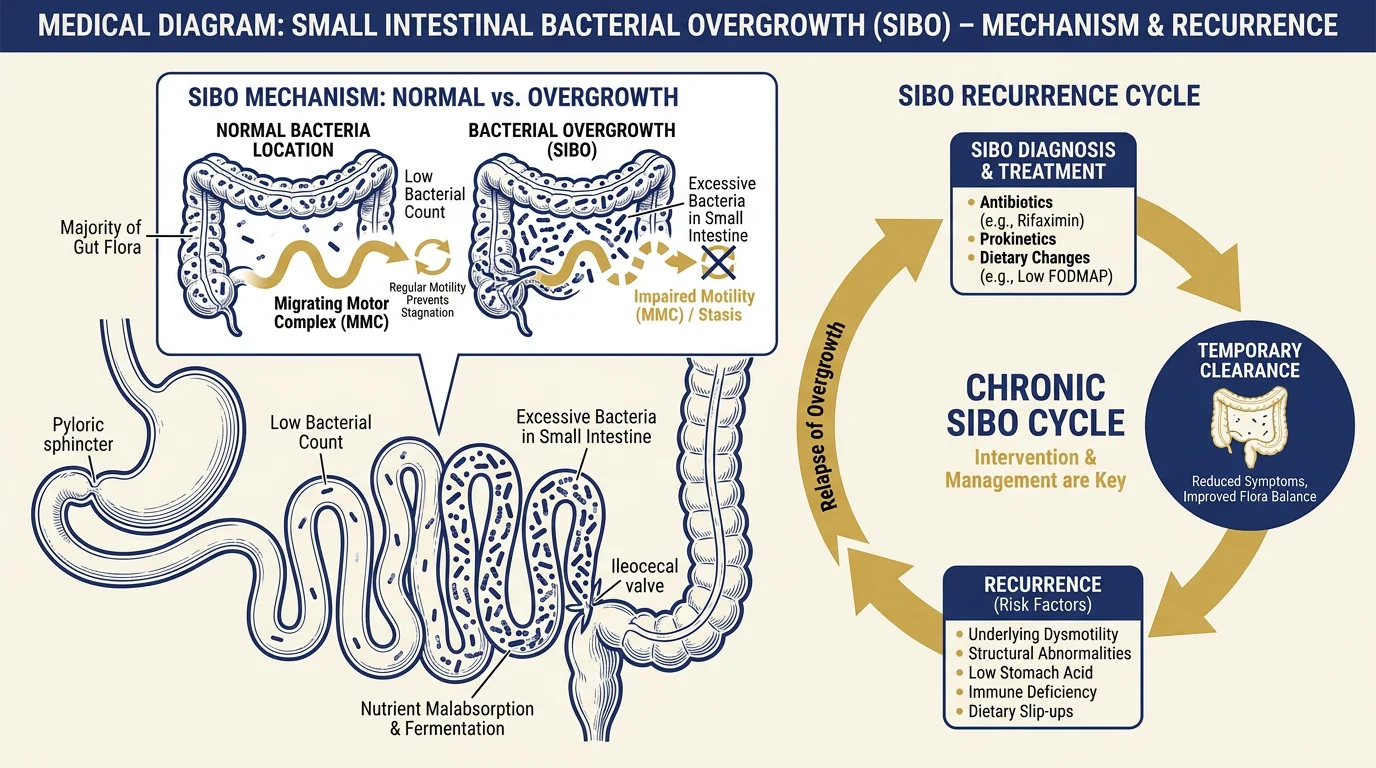
Here is what almost nobody explains. SIBO is not really the disease. It is a consequence. Something allowed bacteria to overgrow in the small intestine where they should not be, and unless that something is corrected, killing the bacteria just clears the stage for them to return. The reason your SIBO keeps coming back is that the treatment addressed the overgrowth but never the reason it was able to happen.
Why SIBO recurs
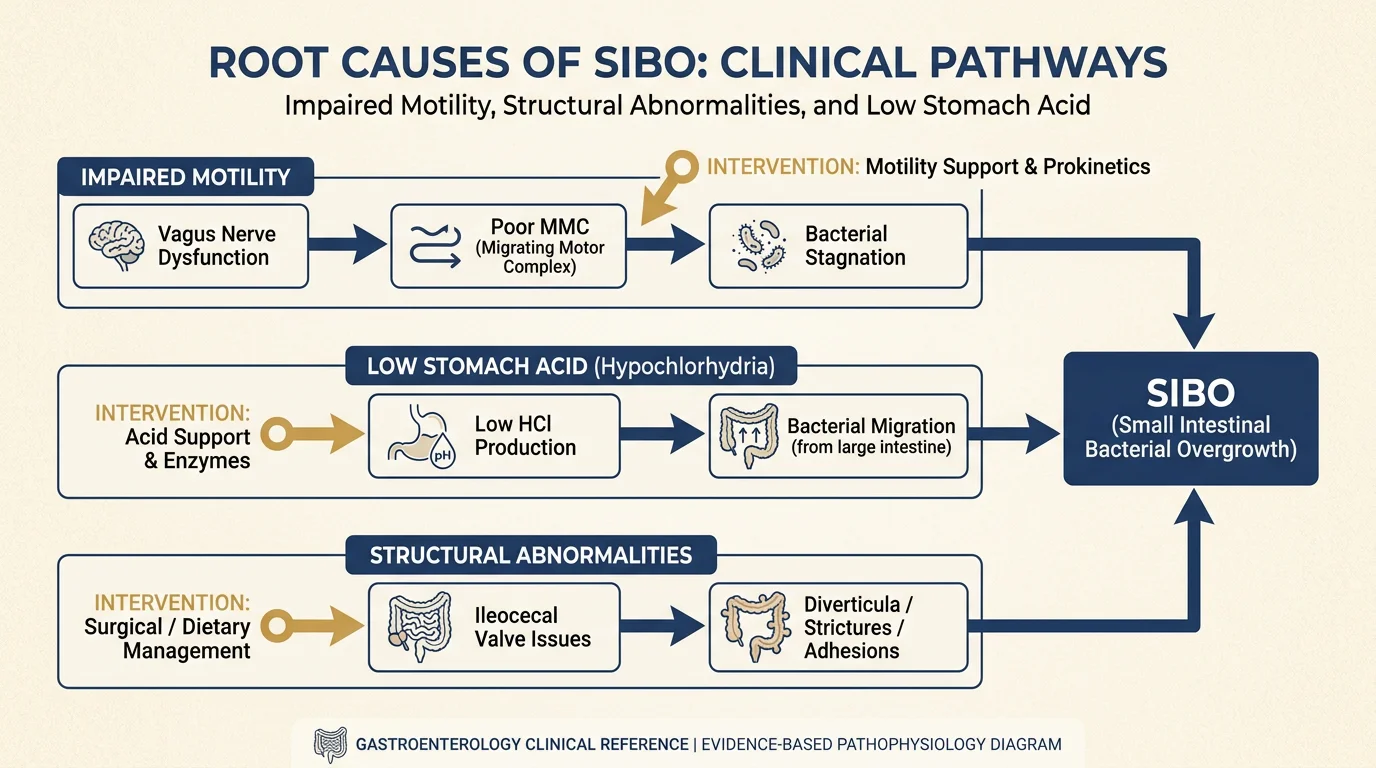
The small intestine is meant to be relatively clean. It is kept that way by a sweeping wave of movement between meals, the migrating motor complex, that clears bacteria downward, and by stomach acid and bile that keep numbers in check. When that sweep slows, or acid and bile are low, the small intestine becomes a stagnant environment where bacteria settle and multiply. That is SIBO 1.
So the overgrowth is downstream of a motility or digestion problem. Common triggers include a bout of food poisoning that damages the nerves driving the sweep, repeated antibiotics, low stomach acid, sluggish bile flow 5, and structural or stress-related slowing of the gut. Treat the bacteria without restoring the sweep and the bile flow 2, and you have cleared the symptom while leaving the cause fully intact. The overgrowth returns because the conditions that produced it are unchanged.
A real case
Marcus tracked his decline to a single trip. A severe bout of food poisoning while travelling overseas, followed by two rounds of antibiotics that wiped out his microbiome. Within months he had developed severe bloating, debilitating brain fog and classic SIBO. Previous treatment had targeted the overgrowth directly and kept failing, because the real problem was upstream: the food poisoning had damaged his gut motility, the sweep that should keep the small intestine clean never recovered 3, and the antibiotics had stripped out the beneficial bacteria that would normally hold the balance. One travel disaster had cascaded into years of gut dysfunction.
The fix was not another round of antimicrobials. It was to address the upstream causes, restore motility so the small intestine could clear itself again, support digestion and bile flow, then clear the overgrowth, and only then rebuild the microbiome 6. Treating in that order is what finally broke the recurrence loop that repeated rounds of killing had never touched.
The right order matters
SIBO is the clearest example of why sequence beats intensity. The instinct is to hit the overgrowth harder, a stronger antimicrobial, a longer course. But if motility is not restored, the small intestine is still not being swept, so the overgrowth returns regardless of how hard you killed. The order that works is motility first, then digestion, then clearance, then microbiome rebuild, the same gut repair sequence that underlies every gut case 4. Antimicrobials have their place, but as one step in a sequence, not as the whole strategy. The question is never just “how do I kill the bacteria” but “why did they overgrow, and what stops it happening again.”
Where to start
How SIBO actually develops, and the sequence that stops the recurrence, are in my book.
For recurrent, treatment-resistant SIBO, I take a small number of telehealth patients each year, across Australia and worldwide.
FAQ
Why does my SIBO keep coming back?
Can antibiotics cure SIBO?
What causes SIBO in the first place?
Do I need a breath test?
Will a low-FODMAP diet fix it?
References
- 1 Pimentel M, Saad RJ, Long MD, Rao SSC. ACG Clinical Guideline: Small Intestinal Bacterial Overgrowth. Am J Gastroenterol. 2020;115(2):165-178. view source
- 2 Fasano A. Zonulin and its regulation of intestinal barrier function. Physiol Rev. 2011;91(1):151-175. view source
- 3 Vighi G, Marcucci F, Sensi L, et al. Allergy and the gastrointestinal system. Clin Exp Immunol. 2008;153(S1):3-6. view source
- 4 Fasano A. Leaky gut and autoimmune diseases. Clin Rev Allergy Immunol. 2012;42(1):71-78. view source
- 5 Yano JM, Yu K, Donaldson GP, et al. Indigenous bacteria from the gut microbiota regulate host serotonin biosynthesis. Cell. 2015;161(2):264-276. view source
- 6 Cryan JF, Dinan TG. Mind-altering microorganisms: the impact of the gut microbiota on brain and behaviour. Nat Rev Neurosci. 2012;13(10):701-712. view source