

You have a cupboard, or a drawer, or a whole shelf. Magnesium for sleep, ashwagandha for stress, NAC for detox, a probiotic, a methylated B, something for your thyroid, something for your gut, two or three things a podcast recommended. Fifteen to twenty bottles, hundreds of dollars a month, and a quiet uncertainty about which of them, if any, is actually doing something.
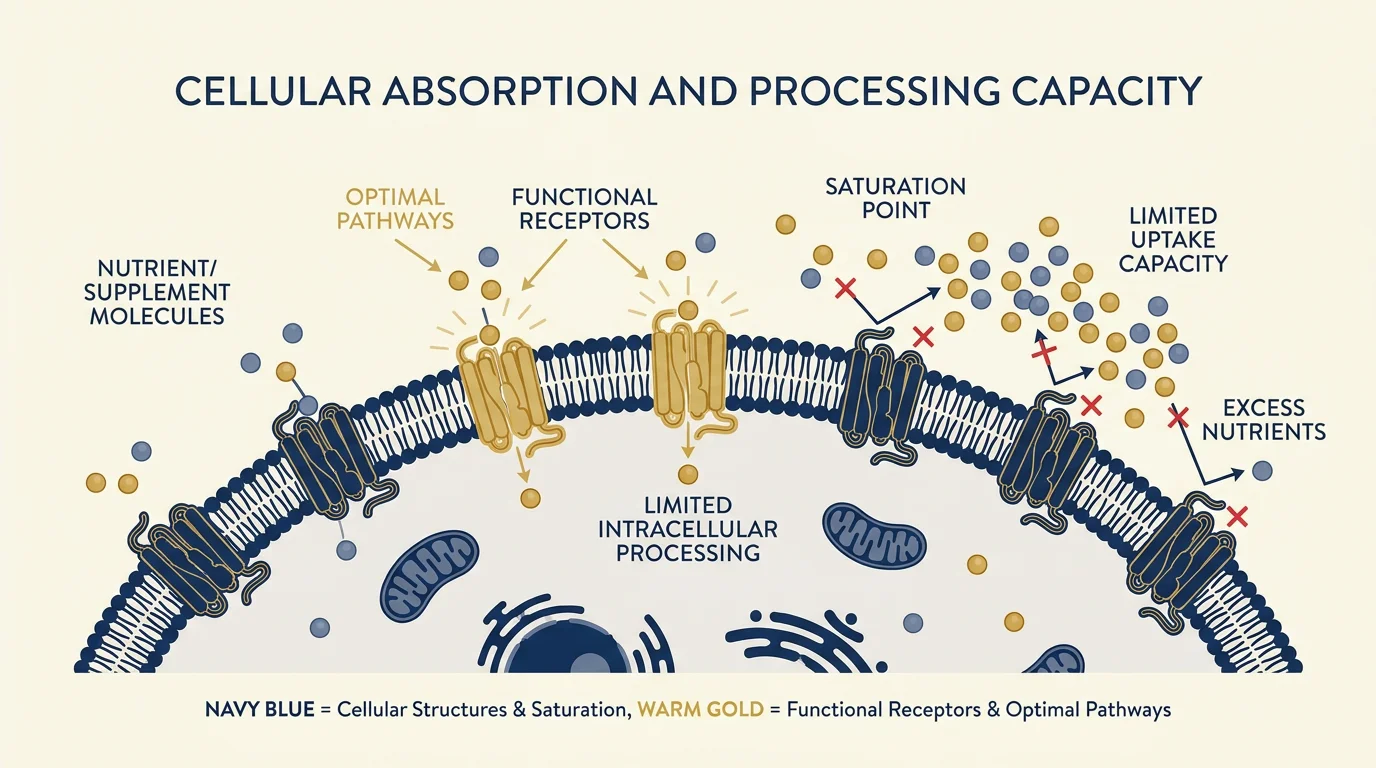
This is supplement stacking, and it is one of the most common and least effective approaches to health I see. Not because the individual supplements are bad, most are perfectly legitimate, but because adding inputs to a system that cannot process them does not produce health. It produces expense, confusion, and sometimes harm. Here is why it fails, and what works instead.
Inputs are not the same as outcomes
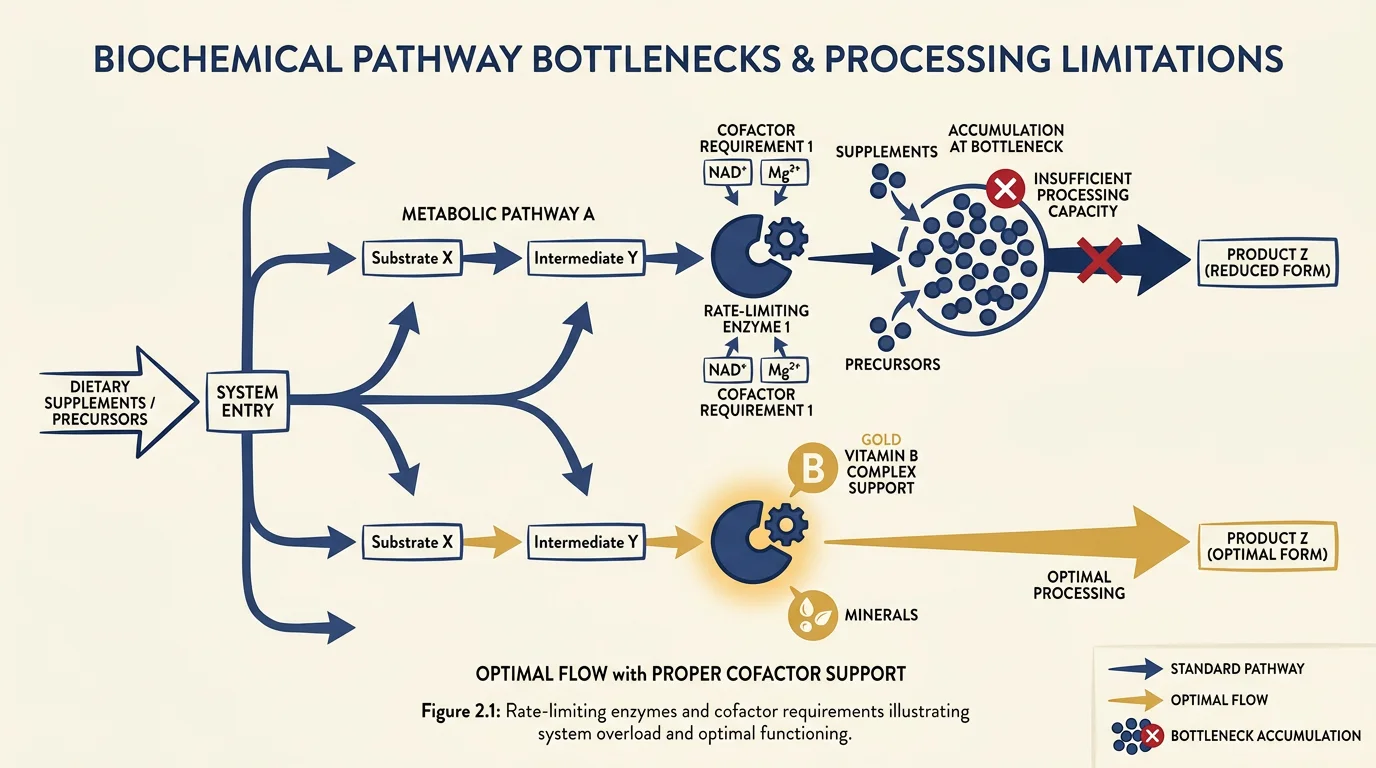
A supplement is an input. For an input to help, your body needs the capacity to process it, and when your underlying systems are dysregulated, more inputs create chaos rather than clarity. This is the core error of stacking: it optimises inputs without first restoring the capacity to use them.
Concrete examples make it obvious. Taking iron when the gut cannot absorb it is wasted 1. Taking methylfolate with a severe B12 deficiency can create a methylation trap 2. Taking probiotics with an active small intestinal overgrowth can feed the overgrowth 3. Taking adaptogenic herbs into a severely dysregulated stress system can overstimulate it 5. In each case the supplement is reasonable in isolation and wrong for the state of the body receiving it. The bottleneck was never the missing input. It was the system’s inability to use what it was given.
Sequence matters more than substances
The reason stacking fails and sequencing works comes down to a single principle: order beats ingredients. A supplement given at the wrong point in the sequence either does nothing or does harm, while the same supplement at the right point works.
Alex is the clearest example. Before he came to see me, a well-meaning practitioner had given him NAC for detoxification and 5-HTP for anxiety. Both are clinically valid choices. But without first addressing his gut overgrowth and his depleted cofactors, neither had any meaningful effect 3. The supplements were not wrong. The sequence was. And the wrong supplement in an already-sensitised system does not just waste money, it can trigger a reaction that sets recovery back months. This is the deeper cost of stacking: not just the dollars, but the lost time and the deepening sense that nothing works.
The three phases that actually work
The approach that works replaces a flat pile of supplements with a sequence of three phases, each creating the conditions for the next.
Phase one, stabilise. Calm the inflammation, repair the gut barrier, address immediate deficiencies, and steady the foundations. Minimal supplementation, aimed at the base.
Phase two, clear. Once the foundation is stable, remove what is driving the problem, pathogens, dysbiosis, toxins, and restore methylation and detoxification with targeted support.
Phase three, optimise. Only once the systems are online do you add the fuller support, hormonal balance, neurotransmitter precursors, mitochondrial and longevity support, the things stacking tries to do first.
Skip a phase and the interventions in the next one either fail or produce unpredictable results 4. This is why the order is not a detail. It is the strategy.
Less, but in order
The shift is counterintuitive because it means doing less, not more. A well-built plan often has fewer supplements than the stack it replaces, but each one is there for a reason, with a known job and an exit point. There is even a predictable moment, usually around month three or four, when a long list becomes overwhelming and people quietly abandon it. That is not a willpower failure. It is what happens when a plan has no logic the person can see. A sequenced plan, where you understand why each thing is there and when it comes out, is one you can actually follow. Stop stacking. Start mapping. Then build in order.
Where to start
The three-phase approach, and how to build a sequenced plan from your own data, are in my book.
For help building a precise, sequenced plan, I take a small number of telehealth patients each year, across Australia and worldwide.
FAQ
How many supplements should I be taking?
Why isn't my supplement routine working?
Can taking the wrong supplements make me worse?
What is the right order to take supplements in?
How do I know which supplements I actually need?
References
- 1 Holotranscobalamin (active B12) and methylmalonic acid as functional markers of B12 status; total serum B12 is relatively insensitive (holotranscobalamin diagnostic literature). view source
- 2 Liew SC, Gupta ED. MTHFR C677T polymorphism: epidemiology, metabolism and the associated diseases. Eur J Med Genet. 2015;58(1):1-10. view source
- 3 Pimentel M, Saad RJ, Long MD, Rao SSC. ACG Clinical Guideline: Small Intestinal Bacterial Overgrowth. Am J Gastroenterol. 2020;115(2):165-178. view source
- 4 Fasano A. Zonulin and its regulation of intestinal barrier function. Physiol Rev. 2011;91(1):151-175. view source
- 5 Vighi G, Marcucci F, Sensi L, et al. Allergy and the gastrointestinal system. Clin Exp Immunol. 2008;153(S1):3-6. view source
- 6 McEwen BS. Stress, adaptation, and disease: allostasis and allostatic overload. Ann N Y Acad Sci. 1998;840:33-44. view source