
If you have a thyroid problem that will not settle, you have probably had one of two experiences. Either your tests came back "normal" while you felt anything but, or you were put on thyroid medication that moved the numbers on paper while your symptoms barely budged. Fatigue, weight that will not shift, cold hands and feet, hair thinning, brain fog, low mood, irregular cycles. The label said the thyroid was being managed. Your body disagreed.
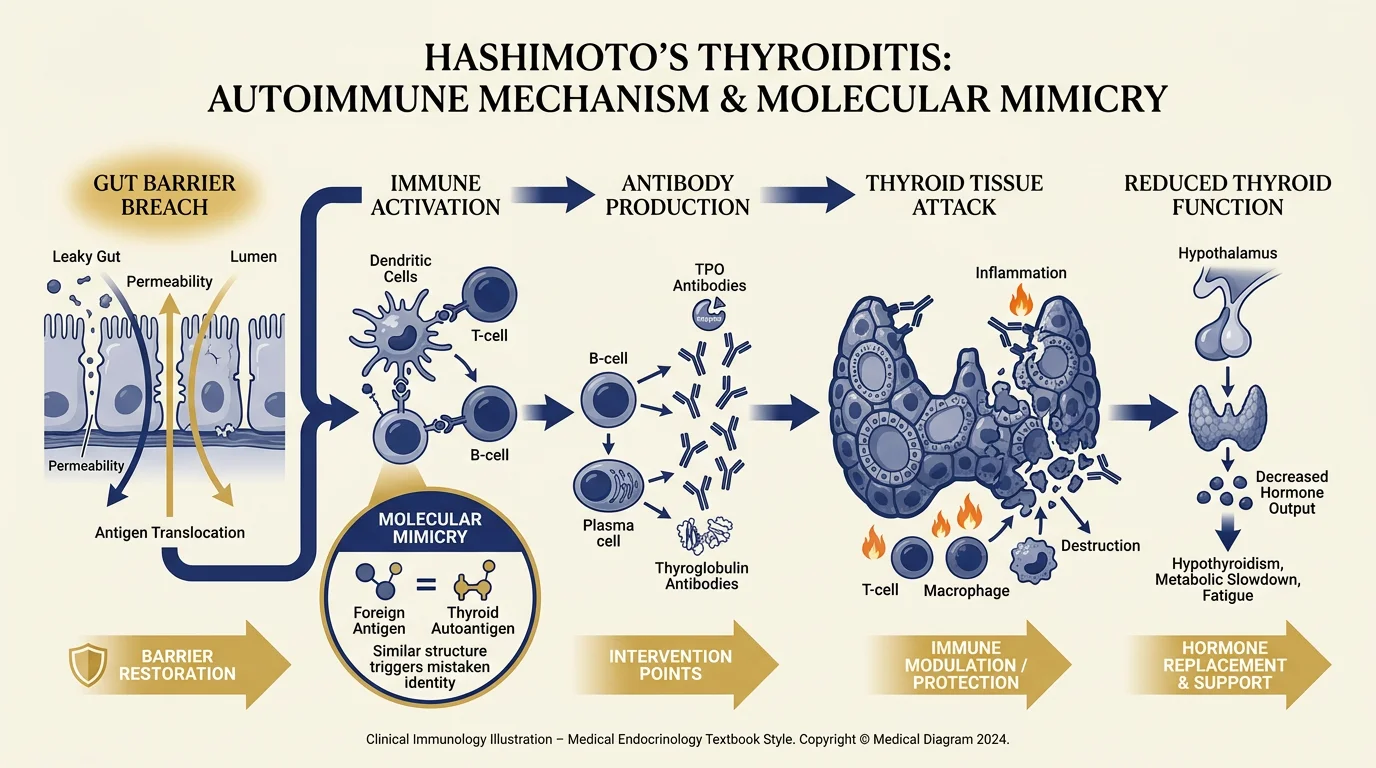
After more than a decade in clinical practice, here is what I have learned about the thyroid. It almost never fails on its own. It fails because something upstream is forcing it to. Treat the gland in isolation and you are managing an output while the input keeps driving it the wrong way. Treat the upstream drivers in the right order and the thyroid very often recovers.
Why “normal” thyroid tests miss the problem
Most thyroid testing stops at TSH, and TSH is not a thyroid hormone. It is a pituitary signal. It tells you the brain is asking the thyroid to work, but nothing about whether the thyroid is converting its hormone into the active form, whether that active form is reaching your cells 6, or whether your immune system is attacking the gland. A TSH sitting at 4.8 is inside most laboratory ranges, but it is well above the optimal threshold of around 2.0, and a person there can feel profoundly unwell 3.
A proper thyroid picture needs the full panel: TSH, free T3, free T4, reverse T3, and crucially the two antibodies, TPO and thyroglobulin. The antibodies are what reveal Hashimoto’s, the autoimmune thyroid condition that is the most common cause of hypothyroidism, and they are exactly what standard testing leaves out 1. You can have raging autoimmune activity for years while your TSH still reads “normal.”
This is the optimal-versus-normal gap, and the thyroid is where it does the most damage. Normal means not yet diseased. It does not mean working well.
The thyroid is a network, not a gland
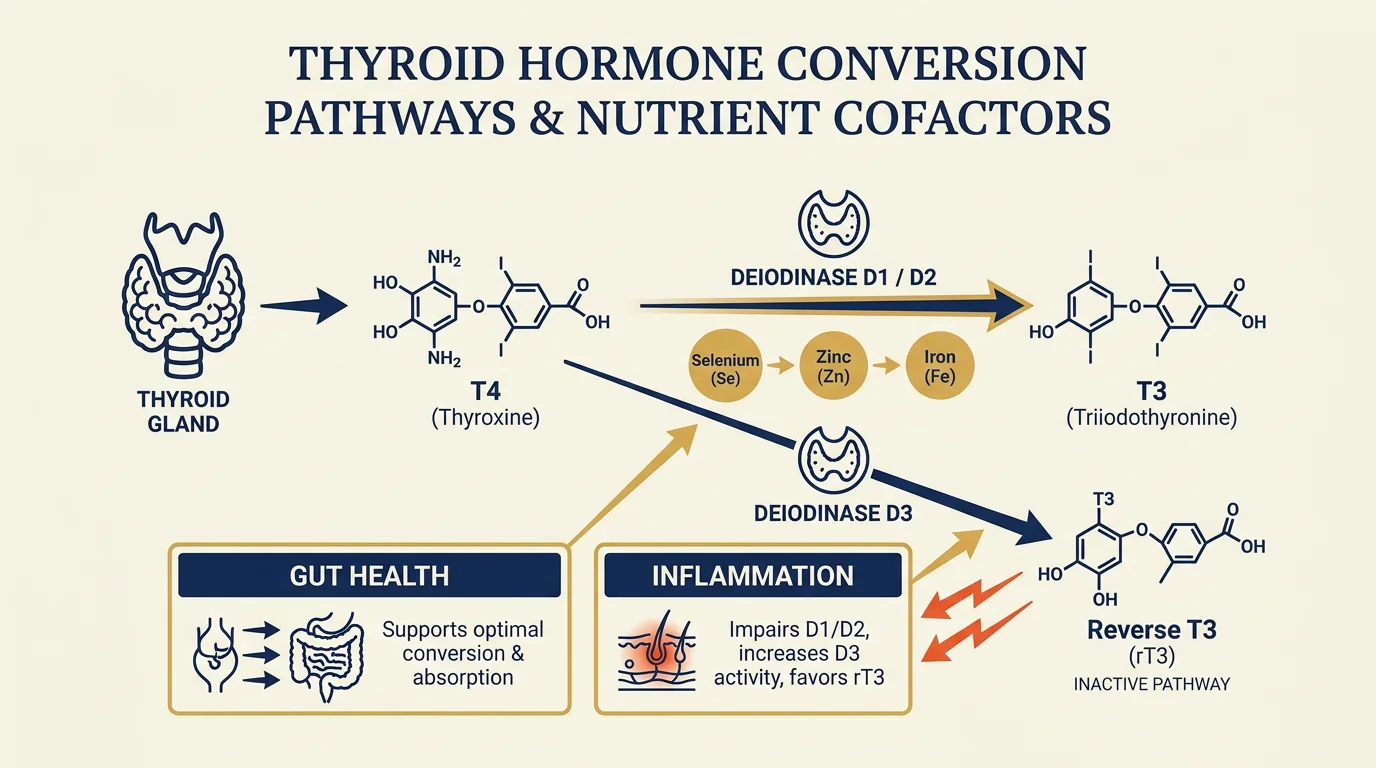
The reason treating the gland alone fails is that the thyroid sits downstream of almost everything else. Three connections matter most.
The thyroid and the gut. The gut produces precursors for thyroid hormone, and low stomach acid, common in Hashimoto’s, impairs absorption of the iron, zinc, selenium and B12 the thyroid depends on. Worse, intestinal permeability drives the autoimmune attack itself through molecular mimicry, where the immune system confuses thyroid tissue with food and bacterial proteins crossing a leaky barrier 12. Gluten is a frequent trigger here 1. This creates a self-perpetuating loop: a leaky gut drives the autoimmune attack, the thyroid dysfunction slows gut motility and stomach acid, and the resulting malabsorption deepens the nutrient deficiencies the thyroid needs. Break the loop at the gut, or thyroid treatment stays a holding pattern.
The thyroid and stress. Chronic stress raises cortisol, which suppresses TSH and impairs the conversion of T4 into active T3. The body downregulates the thyroid on purpose to conserve energy under threat. It is protective in the short term and pathological when the stress never resolves. This is why stressed patients often have subclinical hypothyroidism that does not fully respond to medication, the nervous system is suppressing the thyroid as a survival strategy, and a prescription cannot override that signal while the stress persists.
The thyroid and sex hormones. Low progesterone worsens thyroid function, and high oestrogen blocks thyroid receptors, preventing hormone from reaching cells even when blood levels look adequate. Oestrogen dominance, often driven by sluggish detoxification and a high beta-glucuronidase in the gut that recycles oestrogen back into the body, is one of the most overlooked reasons thyroid symptoms persist.
So the thyroid is the smoke. The gut, the nervous system, the nutrients and the sex hormones are the fire.
A real case
Emma arrived in her mid-thirties with fatigue, weight gain, cold intolerance, hair loss, anxiety and irregular periods. She had been told her thyroid was “borderline” and handed an antidepressant for the anxiety. Like most motivated patients, she had then restricted calories harder, trained more, and tried generic thyroid-support supplements. Each step left her more depleted and her cycle more erratic.
A proper assessment showed why. Her TPO antibodies were 485 against a normal below 34, and her thyroglobulin antibodies 320 against a normal below 115, a sustained autoimmune assault on the gland. Her TSH was 4.8, technically in range, with free T3 and T4 both low-normal, so the thyroid was producing some hormone but not converting it well. Her minerals explained the conversion problem: selenium low, the mineral most critical for converting T4 to active T3 and for lowering antibodies 5; zinc low; iodine low but unsafe to supplement into active autoimmunity without selenium first; and copper elevated, antagonising the zinc. Her gut told the rest of the story, with zonulin at 196 against a normal below 107, the barrier wide open and feeding the autoimmune fire 4, and an elevated beta-glucuronidase recycling oestrogen back into her system. Her day-21 progesterone was 12 against an optimal above 30.
Her thyroid was not failing in isolation. It was overloaded from every direction.
We did not start with the thyroid. We repaired the gut first, then restored selenium and zinc, supported her detoxification and methylation so the oestrogen could clear, rebalanced the sex hormones, and only at month seven trialled iodine cautiously, once it was safe. At nine months her TPO had fallen from 485 to 95, her thyroglobulin antibodies from 320 to 68, her TSH to 1.5, free T3 and T4 into optimal range, her gut barrier sealed, and her progesterone restored. Her energy returned, the cold intolerance resolved, her hair regrew, and her weight stabilised without restriction, because her body finally came out of siege mode.
Emma’s antibody drop sits at the higher end of what I see. Reductions of forty to sixty per cent are more typical in this timeframe, depending on how long the autoimmune process has been running. But the direction is consistent. Address the drivers in sequence and the antibodies fall. We did not cure the genetic susceptibility. We removed the load that was fuelling it.
Where thyroid treatment goes wrong
The most common mistake is treating the gland directly while the upstream drivers are untouched. Thyroid medication when the gut is still leaking, iodine into active autoimmunity without selenium (which pours fuel on the fire), generic thyroid-support supplements aimed at the output. None of these are wrong in principle. They are wrong in sequence. The thyroid is the fourth level of the Healing Hierarchy, the hormones-and-optimisation level, and it can only come right once crisis, gut and biochemistry beneath it are stable.
There are times when direct hormonal support is the right next step, when the gland genuinely cannot recover and the upstream work has been done. The principle is simple: replacement is appropriate when the gland cannot recover, not when the system has not been assessed.
Where to start
The full thyroid picture, the testing, and the sequence that resolves it are laid out in my book.
For complex thyroid and autoimmune cases, I take a small number of telehealth patients each year, across Australia and worldwide.
FAQ
Can Hashimoto's be reversed?
My thyroid tests are normal but I have every symptom. What's going on?
Should I take iodine for my thyroid?
Why didn't my thyroid medication fix my symptoms?
Is gluten really a problem for the thyroid?
References
- 1 Vojdani A, Kharrazian D, Mukherjee PS. The prevalence of antibodies against wheat and milk proteins in blood donors and their contribution to neuroimmune reactivities. Nutrients. 2014;6(1):15-36. view source
- 2 Fasano A. Leaky gut and autoimmune diseases. Clin Rev Allergy Immunol. 2012;42(1):71-78. view source
- 3 Negro R, Schwartz A, Gismondi R, et al. Increased pregnancy loss rate in thyroid antibody negative women with TSH levels between 2.5 and 5.0 in the first trimester. J Clin Endocrinol Metab. 2010;95(9):E44-E48. view source
- 4 Fasano A. Zonulin and its regulation of intestinal barrier function. Physiol Rev. 2011;91(1):151-175. view source
- 5 Huwiler VV, Maissen-Abgottspon S, Stanga Z, et al. Selenium supplementation in patients with Hashimoto thyroiditis: a systematic review and meta-analysis of randomized clinical trials. Thyroid. 2024. view source
- 6 Mullur R, Liu YY, Brent GA. Thyroid hormone regulation of metabolism. Physiol Rev. 2014;94(2):355-382. view source