
Most people track their health by how they feel on a given day. The trouble is that a single good day tells you very little, and a single bad day even less. In chronic illness the real question is not how you feel today. It is how predictable and resilient your body has become over time.
That is what the Stability Score measures. A simple zero to ten read on whether your body is reactive and unreliable, or steady and able to handle what life throws at it. It is the number I use to decide where someone is in their recovery, what to focus on next, and when to move from one phase of the work to the next. It is also the clearest way to tell whether you are still operating beyond your Sensitization Threshold or whether the buffer is rebuilding.
Why feeling is a poor measure
The day-to-day way most people judge their progress is genuinely misleading, for two reasons. First, symptoms fluctuate for all sorts of reasons that have nothing to do with whether the underlying system is healing, a good night’s sleep, a quiet week, a placebo lift from starting something new. Second, and more importantly, symptoms can quieten while the underlying system is still fragile. That is exactly why people relapse the moment life gets hard: the symptoms had settled, but the capacity underneath had not been rebuilt, so the first real stressor brought everything back.
The Stability Score is designed to measure the thing that actually predicts lasting recovery, your body’s capacity to respond to demand and bounce back from stress. It tracks resilience, not just the absence of symptoms on a calm day 3.
The four zones
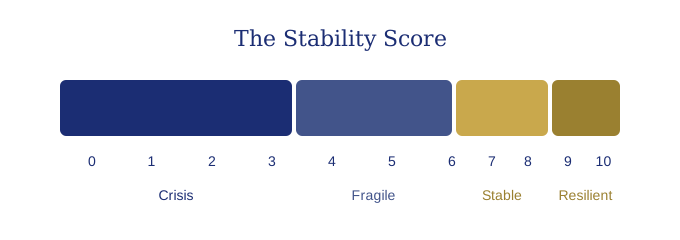
Zero to three: crisis
Symptoms are unpredictable. Recovery from any stressor is slow and out of proportion to the trigger 1. Life is organised around managing the illness, and good days are rare and unreliable. People here have often seen multiple practitioners without lasting improvement. At this level the priority is not optimisation. It is stabilisation, settling the foundation, sleep, blood sugar, nervous system, before anything else is attempted. Adding more interventions at this stage usually makes things worse 2.
Four to six: fragile but improving
Good days are appearing, but setbacks are still common and the fear of regression is constant. You may understand the framework and have started adjusting your foundations, but the gains do not yet feel secure. The work here is structure and sequence, moving through the restoration steps in the right order, without guesswork, so the improvements start to hold rather than slipping away after a hard week.
Seven to eight: stable
Occasional flares still happen, but they are tied to identifiable triggers and the body recovers within a reasonable timeframe. The buffer is rebuilding. You can have an off day without it cascading into an off month. At this level the focus shifts from recovery to maintaining and refining what you have built, and to staying ahead of any drift rather than recovering from collapse.
Nine to ten: resilient
The body handles the demands of daily life without breaking down. You can have a stressful stretch, a poor night, an occasional indulgence, and recover without a cascade. There is a genuine protective buffer again. This is the goal of the whole process, not the absence of symptoms on a good day, but a body that holds its function under load.
How to use it
Assess monthly, not daily. You want the trend, not the noise of a single day. A weekly tracker that logs sleep, food, movement, stress and digestion gives you the inputs; the Stability Score is the summary number you read off the trend each month.
Use it to decide when to progress. While the score is low, the work stays on stabilisation and the foundations. As it climbs into the fragile zone, you move through the restoration sequence. Once it is stable, you shift to maintenance and optimisation. And when the score plateaus or slips, that is the signal to retest and look again, rather than pushing harder on a plan that has stopped working. A plateau is information, not failure.
For most people the realistic target is to move from a three to a seven or above over six to twelve months, in a way that holds. That timeframe matters. A jump that does not hold is not progress; a slower climb that stays put is.
What it is not
The Stability Score is not a diagnosis. Two people with the same diagnosis can score very differently, because the score measures regulatory stability, not the label on your condition. One person with Hashimoto’s might sit at an eight with a stable, predictable body; another might sit at a three 56. The diagnosis is the same; the capacity is not, and the capacity is what determines how you feel and how you recover. The goal is never to chase a label. It is to get the body responding again, and the score is how you measure whether that is happening.
FAQ
How do I work out my Stability Score?
How often should I check it?
My symptoms improved but my score is still low. Why?
What's a realistic goal?
References
- 1 McEwen BS. Stress, adaptation, and disease: allostasis and allostatic overload. Ann N Y Acad Sci. 1998;840:33-44. view source
- 2 McEwen BS, Stellar E. Stress and the individual: mechanisms leading to disease. Arch Intern Med. 1993;153(18):2093-2101. view source
- 3 Fasano A. Zonulin and its regulation of intestinal barrier function. Physiol Rev. 2011;91(1):151-175. view source
- 4 Vighi G, Marcucci F, Sensi L, et al. Allergy and the gastrointestinal system. Clin Exp Immunol. 2008;153(S1):3-6. view source
- 5 Negro R, Schwartz A, Gismondi R, et al. Increased pregnancy loss rate in thyroid antibody negative women with TSH 2.5-5.0 in the first trimester. J Clin Endocrinol Metab. 2010;95(9):E44-E48. view source
- 6 Mullur R, Liu YY, Brent GA. Thyroid hormone regulation of metabolism. Physiol Rev. 2014;94(2):355-382. view source