
You are tired in a way that sleep does not fix. You rest and wake unrefreshed. Good days cost you the next two. You push through on caffeine and discipline, and the people around you assume you are coping because you look like you are. Meanwhile your blood tests come back "normal" and you are left wondering whether it is in your head.
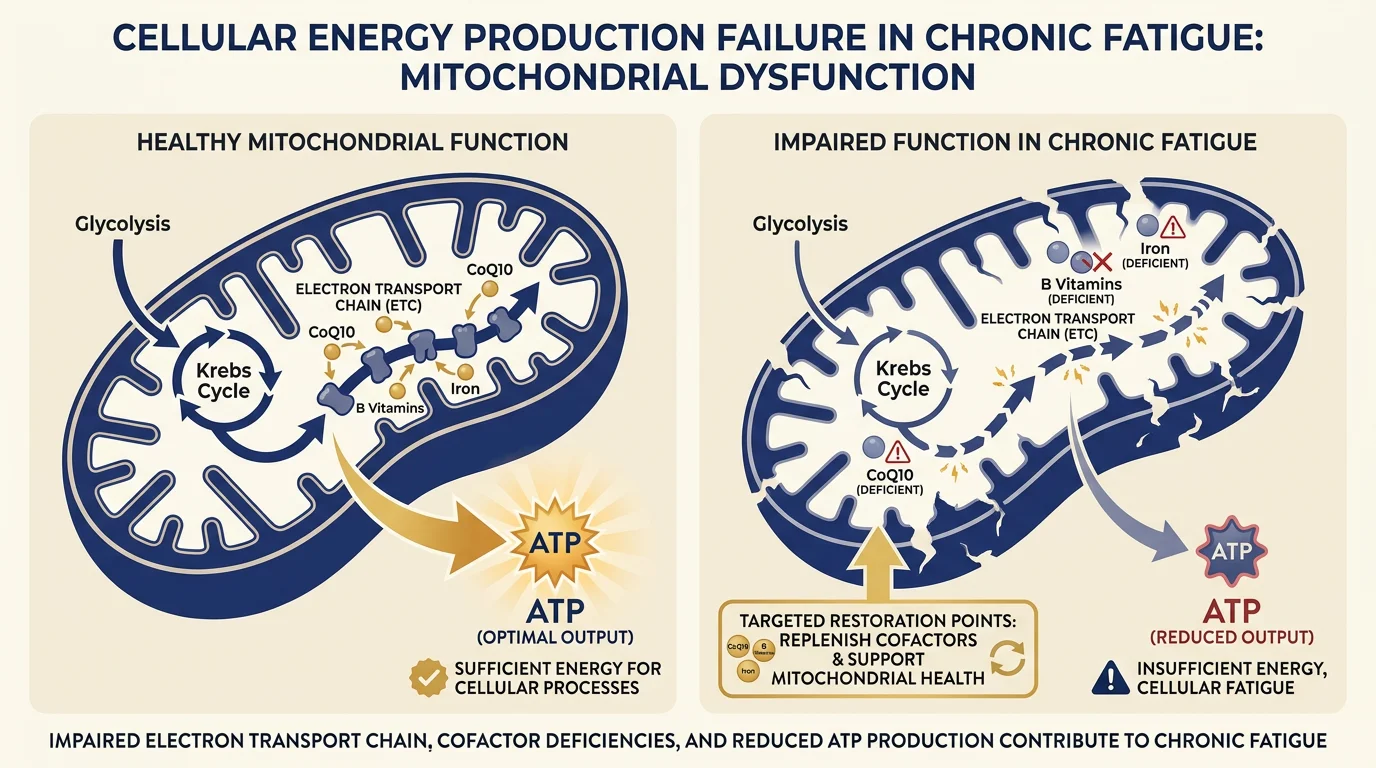
It is not in your head. Fatigue that does not respond to rest is almost always a production problem, your body cannot make enough energy at the cellular level, and the reasons it cannot are specific, findable, and fixable. The trouble is they rarely show up on a standard blood panel, which is why so many people with genuine exhaustion are told everything is fine.
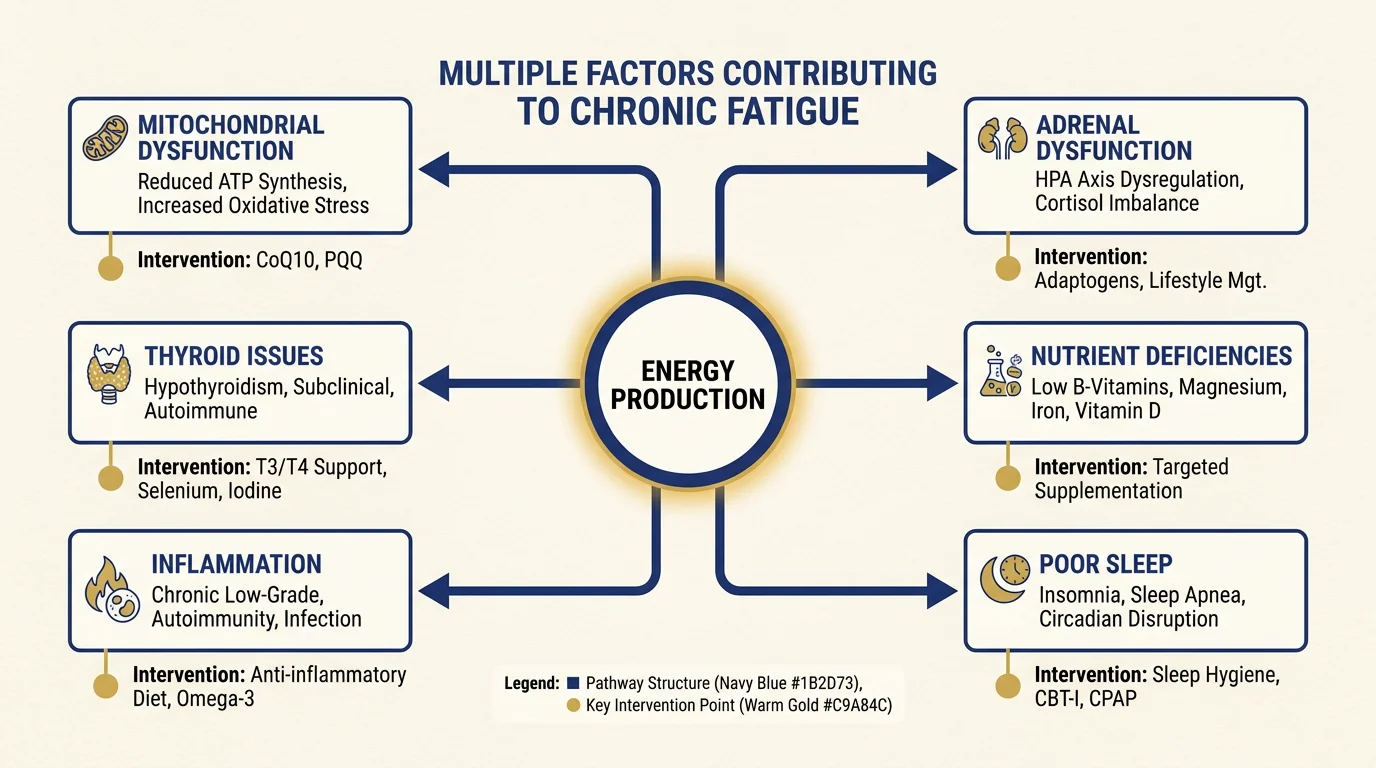
Fatigue is not one thing
The reason fatigue is so often mistreated is that it is not a diagnosis, it is an output, and a dozen different things can lower it. It could be an underactive or poorly converting thyroid. Depleted iron or B12 4. Failing mitochondria, the parts of your cells that actually produce energy 3. A gut infection stealing nutrients and producing toxins. Blood sugar that crashes every afternoon. A methylation bottleneck. Chronic inflammation quietly burning through your reserves. Often it is several of these at once.
Each of those needs a different intervention, and treating the wrong one wastes months. This is why “have more coffee, sleep more, manage your stress” so rarely works for real chronic fatigue, it treats the symptom while the actual driver runs untouched. The job is to find which production problem you have, not to push a tired system harder.
Why standard tests miss it
A standard blood panel checks whether you are diseased. It does not check whether your cells are producing energy well. The two markers that matter most for fatigue, mitochondrial function and cellular nutrient status, barely show up on routine bloods. A ferritin can sit in “normal” range while being far too low for energy. A B12 can look adequate on the total while the active form is depleted. And mitochondrial underperformance does not appear on a standard panel at all.
This is where the organic acids test earns its place. It is a urine test that reflects how well your mitochondria are producing energy 6, your neurotransmitter metabolism, your detox capacity 2, microbial overgrowth, and functional B-vitamin status at a cellular level. It routinely finds the driver of fatigue that blood alone could not see, which is exactly why “your tests are normal” and “I am exhausted” can both be true at the same time.
A real case
James was in his early forties, running a business and raising a young family, and from the outside he looked like he was thriving. Inside, his energy was collapsing. Rest did not restore him, motivation did not translate into stamina, and every good day cost him the next. He had been told he was burnt out and advised to slow down, which did nothing, because burnout was the label, not the cause.
His organic acids test showed the real picture. His glutathione, the body’s main cellular antioxidant, was depleted. He had a high Clostridia load, a gut bacterial overgrowth producing neurotoxins that were interfering with his energy and mood pathways 1. His dopamine precursors were low, which explained the brain fog and the flatness. His homocysteine was 14.8 against an optimal below 7, a sign his methylation was struggling 5, and his testosterone had dropped to 265 against an optimal 450 to 900, the downstream consequence of everything above it.
None of that was visible from his symptoms, which simply said “tired.” We worked in order: cleared the gut interference first, then restored methylation and glutathione, then supported the mitochondria, and only then the hormones. No stimulants, no energy hacks. Eight months on, his homocysteine was 6.2, his testosterone 550, the brain fog gone and the energy back, not borrowed from caffeine but genuinely present. His body had not been failing. Its energy machinery had been blocked, and the blocks had to come out in the right order.
Where fatigue treatment goes wrong
Three mistakes are common. Pushing a depleted system harder with stimulants, which borrows energy you cannot repay. Treating the hormones first, when testosterone or thyroid are usually the consequence of upstream problems, not the origin. And reaching for “adrenal fatigue” as a catch-all, when what is actually going on is more often mitochondrial dysfunction, a methylation bottleneck, or gut-driven inflammation. Fatigue is the fourth-level symptom of a system depleted further upstream. Fix the inputs in order and the output, your energy, follows.
Where to start
The full approach to fatigue, the testing, and the sequence that restores energy are in my book.
For complex, treatment-resistant fatigue, I take a small number of telehealth patients each year, across Australia and worldwide.
FAQ
Why am I exhausted when my blood tests are normal?
Is this just chronic fatigue syndrome?
Is it adrenal fatigue?
Will more sleep or more rest fix it?
What test should I get?
References
- 1 Cryan JF, Dinan TG. Mind-altering microorganisms: the impact of the gut microbiota on brain and behaviour. Nat Rev Neurosci. 2012;13(10):701-712. view source
- 2 Yano JM, Yu K, Donaldson GP, et al. Indigenous bacteria from the gut microbiota regulate host serotonin biosynthesis. Cell. 2015;161(2):264-276. view source
- 3 Mullur R, Liu YY, Brent GA. Thyroid hormone regulation of metabolism. Physiol Rev. 2014;94(2):355-382. view source
- 4 Holotranscobalamin (active B12) and methylmalonic acid as functional markers of B12 status; total serum B12 is a relatively insensitive marker. (Holotranscobalamin diagnostic literature, PMC4681207.) view source
- 5 McEwen BS. Stress, adaptation, and disease: allostasis and allostatic overload. Ann N Y Acad Sci. 1998;840:33-44. view source
- 6 Vighi G, Marcucci F, Sensi L, et al. Allergy and the gastrointestinal system. Clin Exp Immunol. 2008;153(S1):3-6. view source