
There is a kind of exhaustion that does not come from doing too little. It comes from doing everything right and watching nothing change.
There is a kind of exhaustion that does not come from doing too little. It comes from doing everything right and watching nothing change.
You cleaned up the diet. You ran the tests. You took the supplements. You followed the protocols. And somewhere along the way the effort you were putting in stopped matching the results you were getting back. Food that had been fine started producing symptoms. Sleep that had been restorative stopped restoring. The same things that once kept you well simply stopped working.
That mismatch between effort and outcome is one of the most destabilising experiences in chronic illness, and almost nobody explains it. People around you may hint that you are not trying hard enough, or that it is stress, or anxiety, or just age. None of that fits, because you know how hard you are working. Here is what is actually happening. Your body has not failed you. It has crossed a threshold, and no one explained what that meant or what to do about it.
What the threshold is
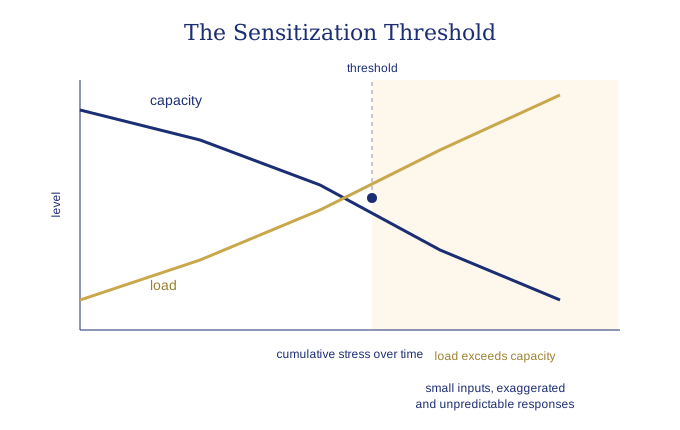
Every body carries a buffer, a reserve of capacity that absorbs the daily demands of living. Stress, a poor night’s sleep, an infection, a stretch of bad food, the body adapts and recalibrates. While that buffer holds, you stay forgiving. You recover from setbacks. Inputs produce predictable outputs, and life feels manageable even when it is busy.
But the buffer is not infinite. When the regulatory systems that maintain it are under sustained load, the buffer declines. And once it declines far enough, something fundamental changes. I call that change the Sensitization Threshold.
It is the point at which cumulative load exceeds what your body can tolerate. The tipping point where normal inputs begin producing abnormal outputs. The research community describes a closely related idea, allostatic load, the cumulative wear on the body’s regulatory systems when they are forced to adapt to chronic stress.1 Bruce McEwen’s work at Rockefeller University established the framework: the body adapts until it cannot, and the cost of that adaptation accumulates silently until the system tips.12 What I see in clinic is the human version of that tipping point, the moment the patient notices that something has changed and cannot put it back.
What it looks like
Before the threshold is crossed, the body compensates. After it is crossed, the same inputs produce different outputs, and the change is unmistakable once you know what you are looking at.
Fatigue persists despite adequate sleep. Weight plateaus despite careful restriction. Gut symptoms continue despite elimination diets. Inflammation stays elevated despite supplementation. Hormones remain chaotic despite targeted intervention. Good days appear and then vanish without explanation, so you can never quite trust a good week to hold.
From the outside it looks like a collection of unrelated problems arriving at once, which is exactly why people get passed between specialists who each see only their own piece. From the inside it is one thing. The body stopped responding predictably. It has not become lazy and it has not turned against you. It has become sensitised. Small inputs now trigger exaggerated responses, because the system is operating without a buffer.3 A meal that should be neutral causes a flare. A workout that should build you up breaks you down. A stressful day that you would once have shrugged off now costs you a week.
What pushes people over
The threshold is rarely crossed by one thing. It is the accumulation, the slow spending of a buffer over years. But there is usually a final stressor, the one too many, that tips a system already running close to the edge. Recognising that moment is often the first step in understanding the whole picture.
In my patients the common triggers are a viral infection, including the lingering effects of COVID, a long stretch of chronic stress from work or caregiving, a hidden dental or root canal infection, severe restriction dieting or over-exercise, a major hormonal shift such as pregnancy loss or menopause,5 steroid exposure, or an environmental trigger like mould. James’s collapse followed three years of sixty-hour weeks, newborn twins, chronic sleep deprivation, and then a root canal infection that pushed an already-spent system into crisis. Claire’s methylation went offline after a third pregnancy loss layered onto chronic stress.6 Rachel’s whole family declined within months of moving into a water-damaged, mould-affected house.4 None of these stressors would tip a body with a full buffer. They tipped a body whose buffer was already gone.
Why adding more does not work
This is the part that matters most, because it is the opposite of what almost everyone tries. Once the threshold is crossed, adding more inputs does not help. Stacking another supplement, another elimination, another protocol onto a sensitised system increases the instability rather than reducing it. The system has lost its capacity to process inputs predictably, so more inputs create more chaos, not more clarity. Input optimisation is not the same thing as regulatory stabilisation, and confusing the two is why protocol fatigue is so common in people who have been unwell for years.
The way back is not more. It is less, then order. Stop stacking. Reduce the cumulative load. Restore the basics first, sleep, blood sugar, nervous system regulation, the foundations that rebuild the buffer. Then map which systems are actually offline and rebuild them in sequence, using the Healing Hierarchy. Stability comes before progress. Restore the stability and effort starts working again, often using the very interventions that failed when they were thrown at a system that could not yet use them.
How to tell where you sit
The Stability Score is a simple zero to ten measure of how predictable and resilient your body has become. It is the clearest way to tell whether you are operating below your threshold or beyond it. A low score means you are sensitised and the priority is stabilisation, not optimisation. A higher score means the buffer is rebuilding and you can begin to push. It gives you a starting position and a number to move, rather than a vague sense of how you feel on the day.
The way back
Crossing the threshold is reversible. The body that became sensitised can become resilient again, because the buffer can be rebuilt. The path is not dramatic and it is not fast, but it is reliable: lower the load, restore the foundations, then work through the systems in order, confirmed by data, so each step holds before you build on it. Most of my patients recognise themselves somewhere between a two and a five on the Stability Score when they start. That is not a verdict. It is a starting position, and the entire point of the framework is to move that number upward in a way that lasts.
Where to start
If this describes you, the most important shift is to stop adding and start mapping. My book lays out exactly how, the threshold, the testing, and the sequence that rebuilds the buffer.
FAQ
Is the Sensitization Threshold the same as adrenal fatigue?
Can the threshold be reversed?
How do I know if I've crossed it?
Why do my supplements make me feel worse now when they used to help?
Is this just stress or anxiety?
References
- 1 McEwen BS. Stress, adaptation, and disease: allostasis and allostatic overload. Ann N Y Acad Sci. 1998;840:33-44. view source
- 2 McEwen BS, Stellar E. Stress and the individual: mechanisms leading to disease. Arch Intern Med. 1993;153(18):2093-2101. view source
- 3 Fasano A. Zonulin and its regulation of intestinal barrier function. Physiol Rev. 2011;91(1):151-175. view source
- 4 Vighi G, Marcucci F, Sensi L, et al. Allergy and the gastrointestinal system. Clin Exp Immunol. 2008;153(S1):3-6. view source
- 5 Mullur R, Liu YY, Brent GA. Thyroid hormone regulation of metabolism. Physiol Rev. 2014;94(2):355-382. view source
- 6 Liew SC, Gupta ED. MTHFR C677T polymorphism: epidemiology, metabolism and the associated diseases. Eur J Med Genet. 2015;58(1):1-10. view source