
When you have been unwell for a long time, you do not have a shortage of symptoms. You have a shortage of clarity. Symptoms point in a direction, but they do not tell you what is driving them, how much, or in what order to address it. Fatigue alone could be thyroid, iron, mitochondrial, gut-driven, blood sugar, sleep debt, or all of them at once. Treating the wrong one wastes months.
When you have been unwell for a long time, you do not have a shortage of symptoms. You have a shortage of clarity. Symptoms point in a direction, but they do not tell you what is driving them, how much, or in what order to address it. Fatigue alone could be thyroid, iron, mitochondrial, gut-driven, blood sugar, sleep debt, or all of them at once. Treating the wrong one wastes months.
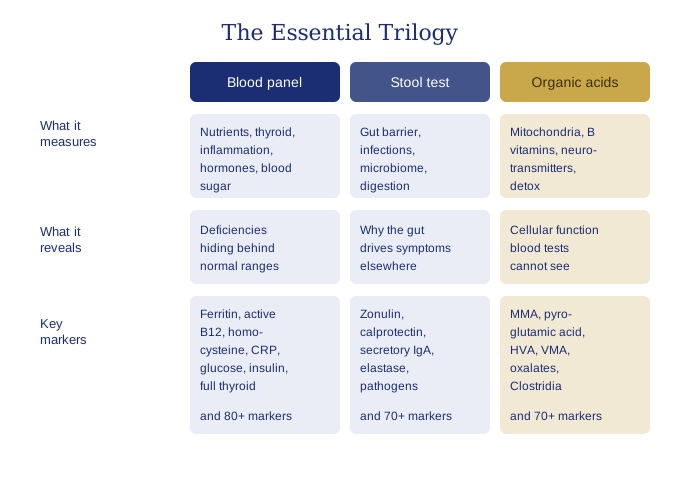
That is what testing is for. Not certainty. Clarity. And in my experience you do not need twenty tests to get it. You need three, read together. An advanced blood panel, an advanced stool test, and an organic acids test. I call them the Essential Trilogy. Each one sees part of the picture. Read together they reveal the pattern, and the pattern shows where to start.
Why symptoms are not enough
Symptoms are real data, but they are ambiguous. The same symptom can have half a dozen different drivers, and the same driver can produce completely different symptoms in two different people. Fatigue is the classic example. It could be an underactive thyroid, depleted iron, failing mitochondria, a gut infection stealing nutrients and producing toxins, blood sugar that crashes every afternoon, or simply years of accumulated sleep debt. Each of those needs a different intervention, and treating the wrong one not only wastes time but can make things worse.
This is why guessing is expensive. People spend years and significant money trialling supplements and diets aimed at a symptom rather than its cause, abandoning each when it does not deliver. The data does not remove the need for clinical judgement, but it narrows six possibilities to one or two, and that is the difference between a plan and a guess.
The three tests
The advanced blood panel
The baseline for everyone. It reveals systemic inflammation through markers like CRP, metabolic health through glucose, insulin and HbA1c, the full thyroid picture rather than TSH alone, sex hormones, cortisol, and nutrient status across iron, vitamin D, B12, folate, magnesium and zinc, plus liver and kidney function.
The key with blood is reading it against optimal ranges, not just the laboratory reference range. The lab range tells you whether you are frankly diseased. The optimal range tells you whether a system is actually functioning well. A great deal of chronic dysfunction lives in the gap between normal and optimal, a TSH of 2.4 that is technically in range but sits above the threshold associated with higher miscarriage risk,1 a B12 that looks adequate on total but is severely low on the active form.2 What the blood panel misses on its own is gut health, mitochondrial function, detox capacity, and neurotransmitter metabolism. Which is why it is the start of the map, not the whole of it.
The advanced stool test
Run when there are gut symptoms, or autoimmunity, skin problems, or chronic inflammation, which in practice is most complex cases. A comprehensive DNA-based stool analysis reveals the microbiome, its diversity and any dysbiosis, the pathogens, bacteria, parasites and fungi, the inflammatory markers such as calprotectin, zonulin and secretory IgA,3 and how well digestion itself is working through markers like pancreatic elastase and bile acids.
This is the test that found the answer in Sarah’s case. Her previous practitioners had treated her autoimmunity by suppressing the immune system. The stool test showed why that was never going to resolve it: a wide-open barrier (zonulin 185, normal below 107), inflammation five times the healthy threshold (calprotectin 285, normal below 50), a near-offline gut immune defence (secretory IgA 142, optimal 510 to 2040), and severe overgrowth of two inflammatory bacteria, Klebsiella and Citrobacter. The immune system was not malfunctioning. It was responding to a gut that had been sending distress signals for over a decade.4 A standard stool culture would have missed all of it. What the stool test does not show is systemic inflammation, nutrient status, or mitochondrial function, which is what the other two cover.
The organic acids test
The one most practitioners never run, and often the one that explains the fatigue nothing else accounts for. A urine test that reflects mitochondrial function and cellular energy production, neurotransmitter metabolism for serotonin, dopamine and GABA,5 detox and methylation capacity, microbial overgrowth such as Clostridia and Candida, and functional B vitamin status at a level blood cannot show.6
James’s case turned on the organic acids test. Labelled with burnout, his OAT showed glutathione depletion and a high Clostridia load producing neurotoxins that were blocking his energy and motivation pathways, alongside low dopamine precursors that explained the brain fog and flatness. That is information you simply cannot get from blood or a stool test alone. What the OAT does not show is structural gut issues or hormone levels. Together with the other two, it completes the picture.
Advanced blood panel
Inflammation, metabolic health, full thyroid, hormones, nutrient status, liver and kidney function, read against optimal ranges.
Gut health, mitochondrial function, detox capacity, neurotransmitter metabolism.
Advanced stool test
Microbiome and dysbiosis, pathogens, inflammatory and barrier markers, digestive function.
Systemic inflammation, nutrient status, mitochondrial function.
Organic acids test
Mitochondrial function, neurotransmitter metabolism, detox and methylation capacity, microbial overgrowth, functional B vitamin status.
Structural gut issues, hormone levels.
Why three, and why together
No single test tells the full story. The power is in the synthesis. A bacterial imbalance on the stool test explains the digestive symptoms. The blood panel shows the nutrient depletion that imbalance is causing. The organic acids test shows the cellular energy failure that depletion is driving. Three results, one pattern, one clear sequence.
I saw this most clearly in a patient who had seen four practitioners over two years. Her blood showed functional deficiencies the others had missed. Her stool test revealed a bacterial imbalance and a leaky barrier that explained why she could not absorb the nutrients she was eating. Her organic acids test showed early mitochondrial underperformance and depleted methylation that explained the fatigue no amount of sleep would fix. No single test told the story. Together they showed a clear chain: a gut barrier problem driving nutrient depletion, driving cellular energy failure, driving every symptom she had been reporting for two years. The starting point became obvious.
This is the difference between data and clarity. A test result is not a treatment plan. It is a data point. The value is in cross-referencing the three, finding the pattern, and building a sequenced plan from what they show together.
Where testing goes wrong
Two mistakes undo most testing. The first is running tests without a framework to interpret them. I have seen patients with twenty pages of data and no plan, who then try to correct every out-of-range marker at once. That is a guaranteed way to overwhelm a sensitised system. The data was never the problem. The absence of a framework to read it was. Testing without someone who can synthesise the picture is like getting a scan with nobody to read it.
The second mistake is reacting to every result the moment it comes back. I run the Trilogy early because I want the full picture from day one. But some of what the data shows, particularly cortisol, blood sugar, and inflammation, reflects the chaos of a destabilised system, and those markers shift on their own once sleep, food, and nervous system regulation are in place. Reading the map is not the same as reacting to every point on it. The framework tells you which findings to act on now and which will resolve as the foundation settles, which is why the Trilogy belongs alongside the Healing Hierarchy, not on its own.
When to add more
The Trilogy gives roughly eighty per cent of the diagnostic clarity most people need. The remaining specialty tests, SIBO breath testing, mycotoxin panels, genetic testing, hair mineral analysis, are added only when the Trilogy points to them, not run reflexively at the start. More testing is not more clarity past a certain point; it is diminishing returns and rising cost. The skill is knowing when the three core tests have answered the question and when one specific add-on is genuinely warranted.
Where to start
The full breakdown of each test, what it reveals, what it misses, and how to decide your next one, is in my book.
FAQ
Which test should I start with?
Can't my GP just run these tests?
Why isn't a standard stool test enough?
How much do the tests cost and is it worth it?
Do I need to retest, and how often?
References
- 1 Negro R, Schwartz A, Gismondi R, et al. Increased pregnancy loss rate in thyroid antibody negative women with TSH 2.5-5.0 in the first trimester. J Clin Endocrinol Metab. 2010;95(9):E44-E48. view source
- 2 Holotranscobalamin (active B12) and methylmalonic acid as functional markers of B12 status; total serum B12 is relatively insensitive (holotranscobalamin diagnostic literature). view source
- 3 Fasano A. Zonulin and its regulation of intestinal barrier function. Physiol Rev. 2011;91(1):151-175. view source
- 4 Vighi G, Marcucci F, Sensi L, et al. Allergy and the gastrointestinal system. Clin Exp Immunol. 2008;153(S1):3-6. view source
- 5 Yano JM, Yu K, Donaldson GP, et al. Indigenous bacteria from the gut microbiota regulate host serotonin biosynthesis. Cell. 2015;161(2):264-276. view source
- 6 Liew SC, Gupta ED. MTHFR C677T polymorphism: epidemiology, metabolism and the associated diseases. Eur J Med Genet. 2015;58(1):1-10. view source