
You feel anxious, wired, on edge, and you have been told it is stress, or your circumstances, or simply how you are made. Maybe you were offered an antidepressant. Maybe talk therapy helped a little but never resolved the underlying hum. And through all of it, a quiet question persists: why does my body feel this way when, on paper, my life is fine?
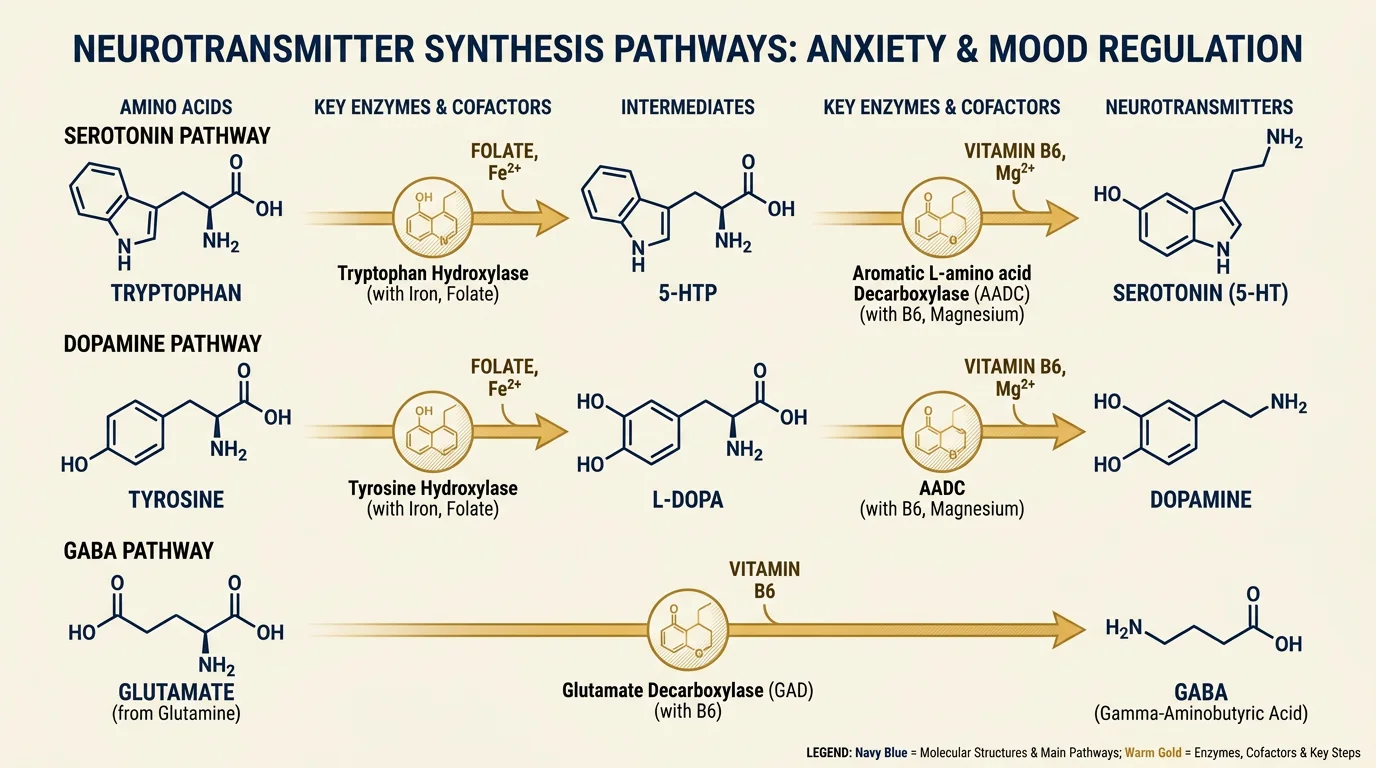
Anxiety is real and it is often, in large part, biochemical. That is not to dismiss the role of life events or trauma, which matter. It is to say that how your brain makes and balances its calming and activating chemicals depends on nutrients, methylation, gut function and inflammation, and when those are off, anxiety can persist no matter how much you work on the psychological side. In my experience the psychological work lands far better once the biochemistry underneath it is corrected.
Anxiety is not just in your head
Your brain runs on neurotransmitters, and it builds them from raw materials. Serotonin and GABA calm you. Dopamine and noradrenaline activate you. Making and balancing these depends on specific nutrients, B6, zinc, magnesium, the active forms of folate and B12, and on methylation, the process that assembles and regulates them. When methylation is off or those cofactors are depleted, the brain cannot keep the calming and activating systems in balance, and anxiety is often the result 1.
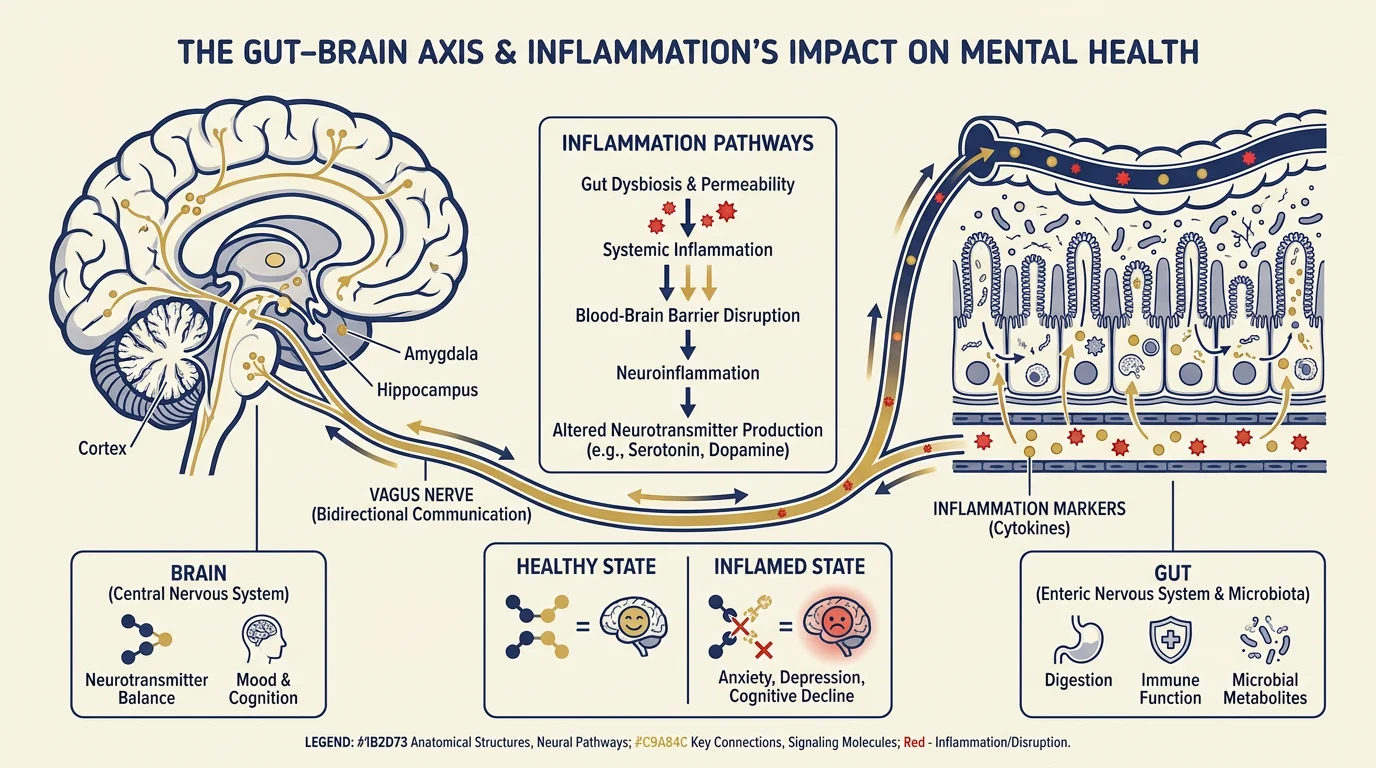
Three drivers come up again and again. Methylation imbalance, where the chemistry that builds neurotransmitters is running wrong. Mineral and cofactor depletion, particularly low zinc and B6 with a disturbed copper-to-zinc ratio. And the gut, where most serotonin is actually produced and where bacterial overgrowth can generate compounds that directly disturb mood 2. None of these show up in a standard anxiety assessment, which is why the biochemical layer is so often missed.
The gut-brain and methylation connection
Two connections matter most. The gut makes the majority of the body’s serotonin, and the gut microbiome directly influences brain chemistry and behaviour through what is now well documented as the gut-brain axis 2. When the gut is dysbiotic, with overgrowths producing neurotoxic compounds, mood and anxiety follow. And methylation, when impaired, throws off the production of the very neurotransmitters that regulate mood, which is one reason people with significant methylation issues so often carry anxiety alongside their physical symptoms 3.
So the productive question is not only “what happened to make me anxious” but also “does my brain have what it needs to make me feel calm.” Often the answer is no, and the reasons are findable.
A real case
Alex was twenty-one, a university student, with anxiety everyone around him put down to study stress. It was not study stress. His testing showed an undermethylation pattern with elevated histamine and depleted neurotransmitter synthesis. He had a pyrrole pattern driving chronic depletion of B6 and zinc, confirmed on his organic acids test with a markedly elevated xanthurenate at 85 against a normal below 40 4. His zinc was severely low at 8.9, his copper elevated at 29, a badly skewed ratio that itself drives anxiety. His homocysteine was 12.4 against an optimal below 7, confirming undermethylation 5. His active neurotransmitter markers showed very low dopamine and low serotonin. And his gut carried a high Clostridia load producing neurotoxins, with low beneficial flora 6.
None of that was visible from “anxious university student.” We worked in order, calming the gut and clearing the Clostridia interference, restoring zinc and B6 and correcting the copper ratio, supporting methylation to rebuild neurotransmitter production, and replenishing glutathione. At five months his homocysteine had normalised to 6.8, his methylation cycle had settled, and the anxiety that had defined his life had lifted, not masked, resolved at the level of the chemistry that was producing it.
Where anxiety treatment goes wrong
The common mistake is treating only the output. Medication and therapy both have their place, and for many people they are genuinely necessary, but when the underlying problem is depleted zinc and B6, a skewed copper ratio, an undermethylation pattern, or a gut producing neurotoxins, neither addresses the cause. The biochemistry keeps generating the anxiety. Another mistake is supplementing precursors like 5-HTP or GABA without first restoring the cofactors needed to use them or clearing the gut interference, which is why those often disappoint. The approach that works is to find the specific biochemical drivers and correct them in sequence, so the brain can make and balance its own chemistry again.
A note: this article is about the physiological contributors to anxiety. If you are struggling, please also reach out to a doctor or mental health professional. The biochemical and the psychological work best together, not as alternatives.
Where to start
How the biochemistry of mood works, and the testing and sequence that address it, are in my book.
For complex cases, I take a small number of telehealth patients each year, across Australia and worldwide.
This article covers physiological contributors to anxiety only. If you are struggling with your mental health, please reach out to a doctor or mental health professional.
FAQ
Can anxiety really be caused by a nutrient deficiency?
What is undermethylation and how does it affect mood?
How does the gut affect anxiety?
Should I just take magnesium or GABA for anxiety?
Is this instead of therapy or medication?
References
- 1 Cryan JF, Dinan TG. Mind-altering microorganisms: the impact of the gut microbiota on brain and behaviour. Nat Rev Neurosci. 2012;13(10):701-712. view source
- 2 Yano JM, Yu K, Donaldson GP, et al. Indigenous bacteria from the gut microbiota regulate host serotonin biosynthesis. Cell. 2015;161(2):264-276. view source
- 3 Liew SC, Gupta ED. MTHFR C677T polymorphism: epidemiology, metabolism and the associated diseases. Eur J Med Genet. 2015;58(1):1-10. view source
- 4 Holotranscobalamin (active B12) and methylmalonic acid as functional markers of B12 status; total serum B12 is relatively insensitive (holotranscobalamin diagnostic literature). view source
- 5 McEwen BS. Stress, adaptation, and disease: allostasis and allostatic overload. Ann N Y Acad Sci. 1998;840:33-44. view source
- 6 Vighi G, Marcucci F, Sensi L, et al. Allergy and the gastrointestinal system. Clin Exp Immunol. 2008;153(S1):3-6. view source