
You took a genetic test, or your practitioner mentioned it, and now you have a label: MTHFR. Maybe a single variant, maybe compound. You have read that it affects everything from energy to mood to miscarriage, and you have probably also read enough conflicting noise to be thoroughly confused about whether it matters at all.
Here is the clear version after more than a decade of working with these patients. MTHFR is real and it matters, but not in the way the internet usually frames it. Your genes are not your destiny. They describe where your processing is slower, not what your outcome must be. The difference between a variant that causes problems and one that never does comes down to load, whether your body has the cofactors, the gut function and the low enough demand to compensate for the slower pathway.
What methylation actually does
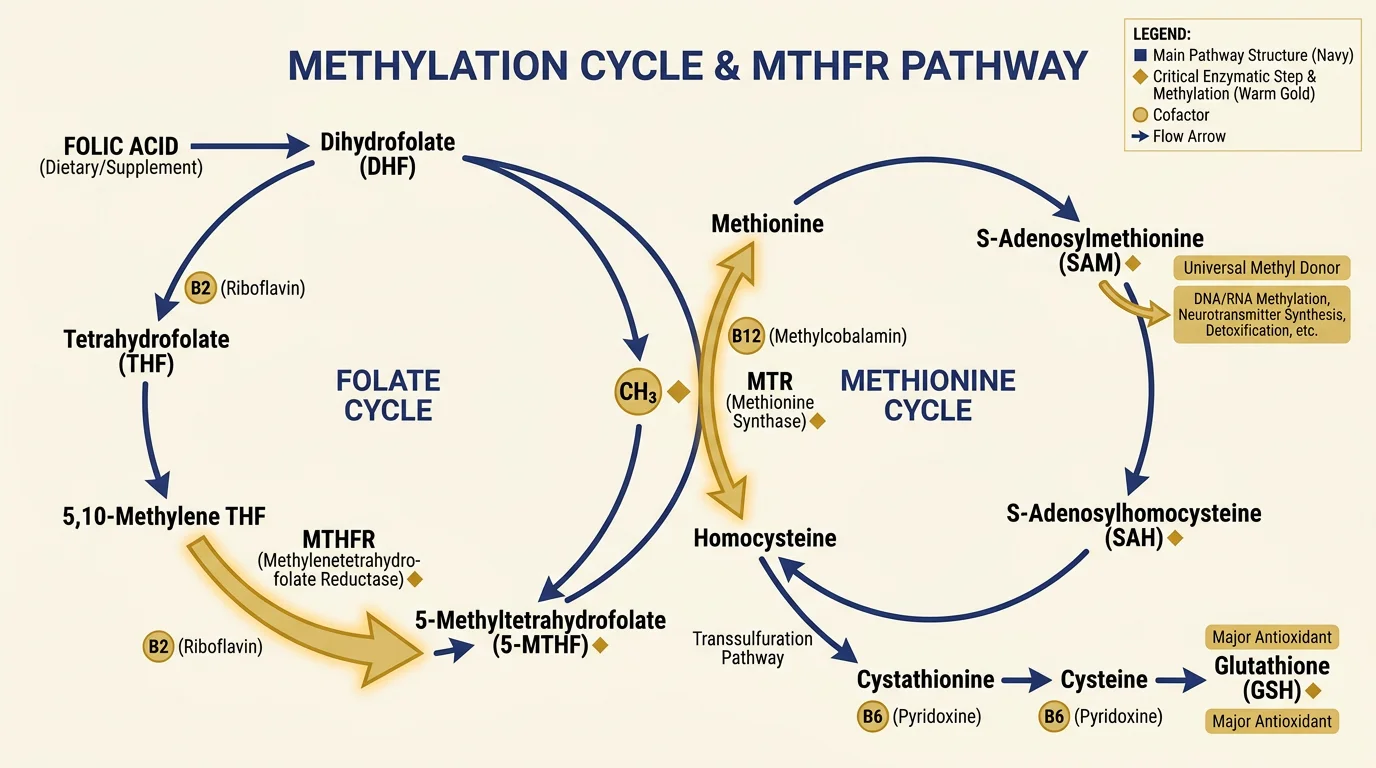
Methylation is one of the most important processes in the body, running billions of times a second. It builds neurotransmitters, regulates genes, processes hormones, supports detoxification, maintains the nervous system, and recycles homocysteine into useful compounds 4. When it runs well, you never think about it. When it runs slowly, the effects show up everywhere at once, which is exactly why MTHFR gets blamed for such a scattered list of symptoms.
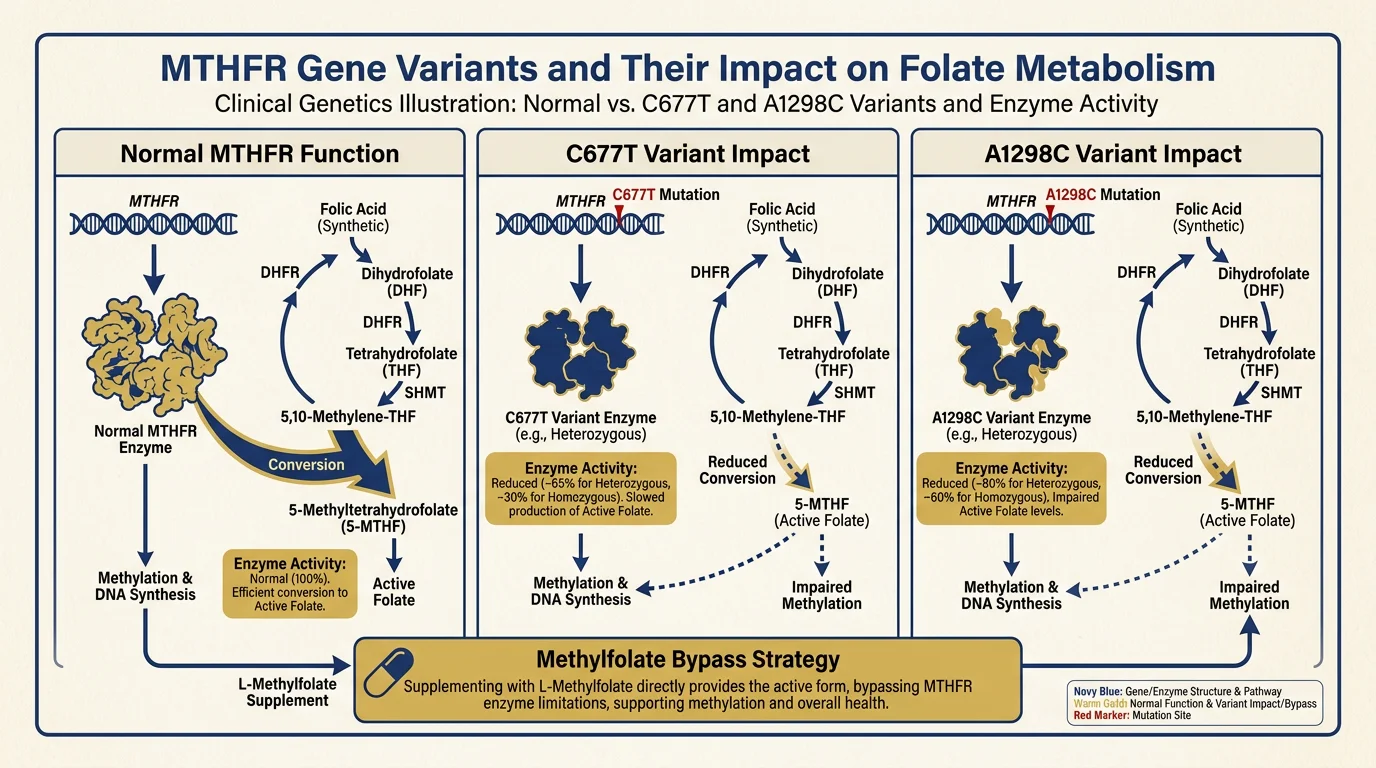
The MTHFR gene codes for an enzyme that converts folate into its active, usable form. The common C677T variant reduces that enzyme’s activity. One copy slows it modestly. Two copies, the homozygous form, can reduce activity by sixty to seventy per cent 1. That does not mean the pathway stops. It means it runs at reduced capacity, and whether that becomes a clinical problem depends on what else is going on.
Genes are instructions, not outcomes
This is the principle that matters most, and it is the one the internet gets wrong. Carrying MTHFR variants tells you your folate conversion is slower than average. It does not tell you whether your folate is adequate, whether your B12 is sufficient, whether your gut can absorb what you need, or whether your methylation is functionally impaired right now. For that you need to measure function, not just genotype 2.
A person with two MTHFR copies and good nutrient status, a healthy gut and low stress can methylate perfectly well. The same genotype under heavy stress, with a depleted gut and low B12, tips into methylation failure. Same genes, different capacity. This is why genetic testing alone is insufficient and why “you have MTHFR” is the start of an investigation, not a diagnosis. The genes give context. Functional tests, the organic acids test, a full blood panel and a stool test, give the actual picture.
A real case
Claire came after three early miscarriages and five years of being told nothing was wrong. She had carried one healthy pregnancy at thirty-two, then could not sustain another. Her genetic picture was not a single variant but a network of bottlenecks: MTHFR C677T homozygous, plus MTR and MTRR variants reducing homocysteine recycling and B12 regeneration, and a CBS variant affecting glutathione. Under load, those converged into one pattern, methylation failure.
The functional data confirmed it. Her homocysteine was 12.6 against an optimal below 7. Her active B12 was 42, severely depleted. Her organic acids test showed elevated methylmalonic acid (tissue-level B12 deficiency, regardless of what serum said), elevated uracil (folate insufficiency in the pathway), and severe glutathione depletion. Her ferritin was 28 where fertility needs 50 to 150, her vitamin D low, her CRP raised. And her gut was inflamed with low secretory IgA and depleted beneficial flora, which mattered enormously, because every methylation cofactor has to be absorbed through the gut 6. Her slow pathway and her leaky gut were feeding each other in a downward spiral 3.
Her first pregnancy succeeded because at thirty-two her reserves were still adequate. Five years of stress, grief, repeated losses and worsening gut function eroded the buffer 5 until her biochemistry could no longer support a pregnancy. Her genes never changed. Her capacity did.
We worked in sequence. First we removed the active blocker, eliminating synthetic folic acid entirely, which for her genotype was competing with the methylfolate she needed. Then we restored gut absorption, then bypassed the bottleneck with methylfolate, active B12 and active B6, then rebuilt glutathione, then optimised for conception. At eight months her homocysteine was 6.2, active B12 128, ferritin 92, vitamin D restored, CRP 0.6, and her day-21 progesterone had risen to a healthy 42. She conceived naturally at month nine, carried to term, and had two more healthy pregnancies in the years after. Her words: she could not understand why nobody had tested any of it before.
Where MTHFR advice goes wrong
Three mistakes are common. Treating the genotype instead of the person, megadosing methylfolate because a test showed a variant, without checking whether it is actually needed or tolerated. Ignoring the gut, when impaired absorption is often what tips a manageable variant into a functional deficiency. And missing the synthetic folic acid problem, where someone with a significant variant keeps taking fortified foods and standard prenatal vitamins that, for them, compete with the active form. The fix is always to measure function, address the gut, remove the blocker, then support the pathway in the right order, not to react to a genotype in isolation.
Where to start
How methylation works, how to read your own markers, and the sequence that restores it are in my book.
For complex methylation and fertility cases, I take a small number of telehealth patients each year, across Australia and worldwide.
FAQ
I have the MTHFR gene. Should I be worried?
What is the difference between folic acid and methylfolate?
Can MTHFR cause miscarriage?
Should I take high-dose methylfolate because I have a variant?
Does MTHFR affect mood and anxiety?
References
- 1 Liew SC, Gupta ED. MTHFR C677T polymorphism: epidemiology, metabolism and the associated diseases. Eur J Med Genet. 2015;58(1):1-10. view source
- 2 Holotranscobalamin (active B12) and methylmalonic acid as functional markers of B12 status; total serum B12 is relatively insensitive (holotranscobalamin diagnostic literature). view source
- 3 Homocysteine metabolism gene polymorphisms (MTHFR C677T, MTHFR A1298C, MTR A2756G and MTRR A66G) jointly elevate the risk of folate deficiency. Int J Mol Sci. 2015;16(8). view source
- 4 Fasano A. Leaky gut and autoimmune diseases. Clin Rev Allergy Immunol. 2012;42(1):71-78. view source
- 5 McEwen BS. Stress, adaptation, and disease: allostasis and allostatic overload. Ann N Y Acad Sci. 1998;840:33-44. view source
- 6 Vighi G, Marcucci F, Sensi L, et al. Allergy and the gastrointestinal system. Clin Exp Immunol. 2008;153(S1):3-6. view source