
Your hormones feel off. Maybe it is fatigue and low libido, maybe irregular or difficult cycles, maybe perimenopausal symptoms that arrived early or hit hard, maybe low testosterone. You may have been offered replacement, or told your levels are "normal," or handed a supplement aimed at the hormone in question. And whatever you tried may have helped briefly before the problem drifted back.
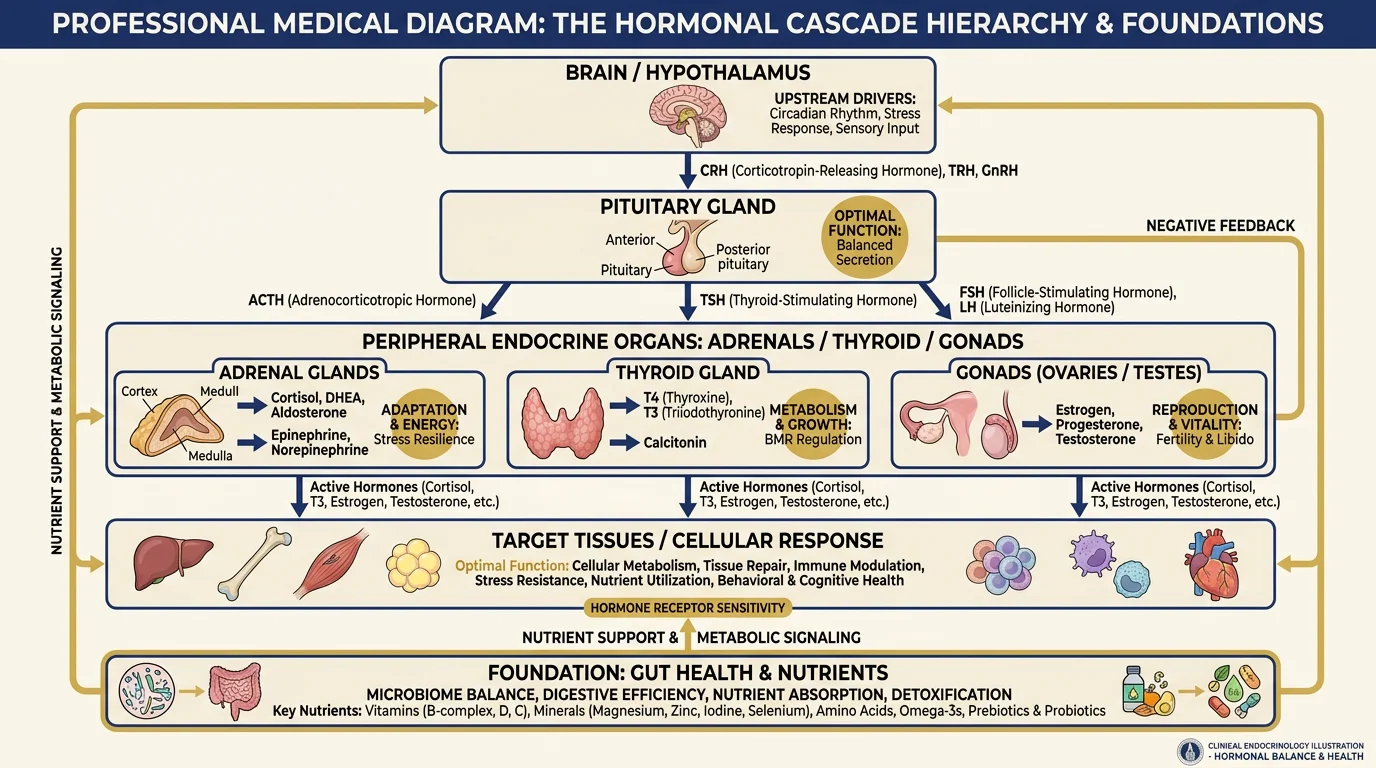
After more than a decade in practice, here is the pattern I see most. Hormones are almost always downstream. They are the output of systems further up the chain, the gut, the nutrients, the nervous system, the detoxification pathways. When those are off, the hormones go off, and treating the hormone directly while the upstream drivers keep pushing the other way is why so many hormone interventions only half-work.
Hormones are the output, not the origin
Think of your hormones as the readout at the end of a long production line. Whether you make enough, convert it properly, deliver it to your cells, and clear it once it is used, all depend on systems upstream. Three connections matter most.
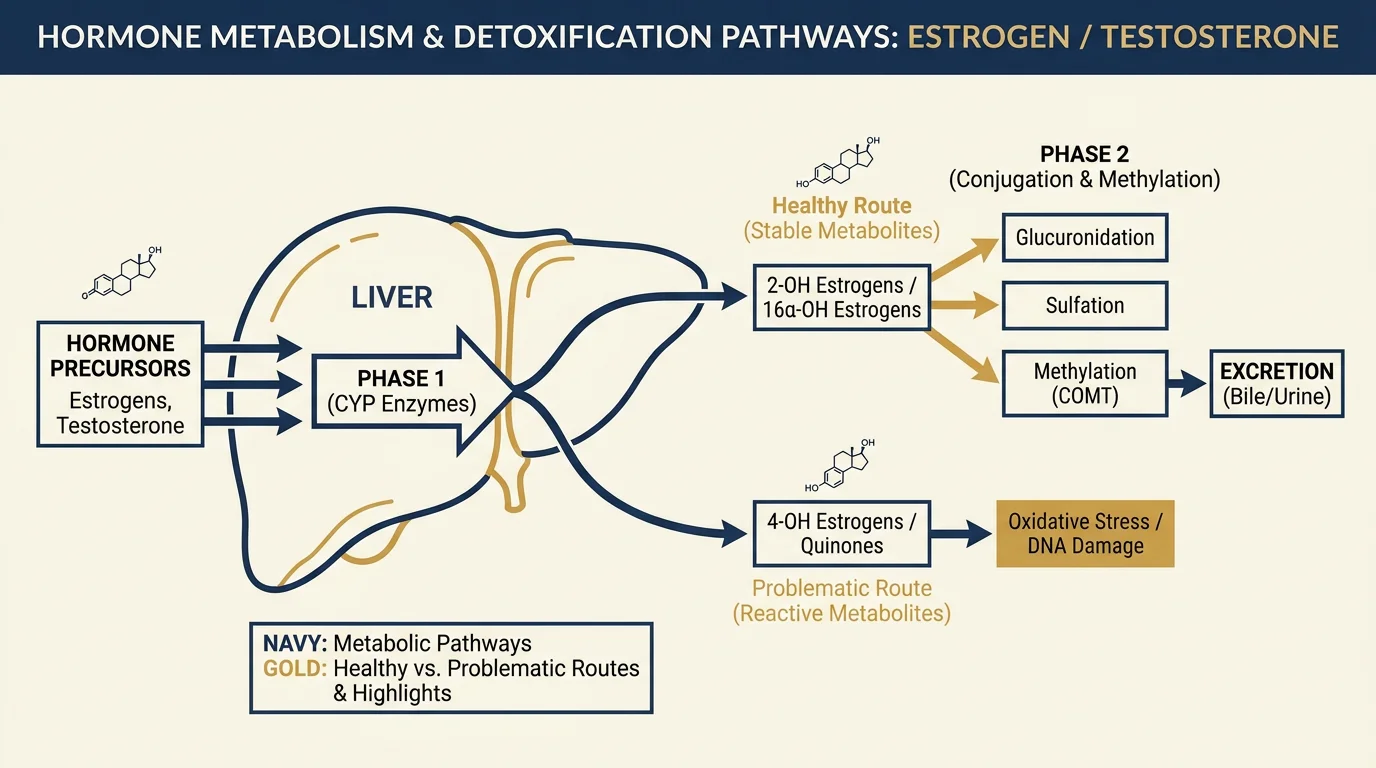
Detoxification and the gut. Used hormones, particularly oestrogen, are processed by the liver and cleared through the gut 3. When detoxification is sluggish or a gut enzyme called beta-glucuronidase is elevated, oestrogen that should have left the body is reactivated and reabsorbed, driving the oestrogen dominance behind so many hormonal symptoms 6.
Nutrients and cofactors. Hormone production and conversion depend on specific nutrients. Without them the production line slows no matter how much you try to push the end product.
Stress and the nervous system. Chronic stress diverts resources away from sex-hormone production and disrupts the whole signalling cascade 4, which is why hormonal symptoms so often worsen in stressful periods.
So the hormone is the symptom. The gut, the nutrients, the detox pathways and the nervous system are usually where the problem actually lives 1.
A real case
Emma’s case shows the pattern exactly, even though it presented as a thyroid problem, because thyroid and sex hormones are part of the same downstream system 5. She had fatigue, weight gain, hair loss, anxiety and irregular periods, and a day-21 progesterone of just 12 against an optimal above 30. The instinct would be to treat the hormones directly. But her progesterone was low because everything upstream was compromised: her gut barrier was wide open, her detoxification was sluggish with elevated beta-glucuronidase recycling oestrogen back into her system, her minerals were depleted, and her thyroid was under autoimmune attack 2. Her oestrogen-to-progesterone balance was a consequence, not a cause.
We did not start with the hormones. We repaired the gut, restored the nutrients, supported detoxification so the excess oestrogen could clear, and addressed the autoimmune drivers. Her hormones followed. By nine months her progesterone had risen to a healthy level, her cycle normalised, and the symptoms that had been labelled hormonal had resolved, because the systems producing them had been restored. As the principle goes, fix the inputs and the output follows.
When direct hormone support is right
Fixing upstream before treating downstream is the foundation of how I approach hormones, but it is not absolute. There are situations where the upstream work has been done, foundational systems are stable, natural support has been trialled, and the hormonal system still needs direct help. In those cases hormonal support is the right next step in the sequence. The principle is simple: replacement is appropriate when the gland genuinely cannot recover, not when the system has not been assessed. The mistake is reaching for replacement first, before anyone has looked at why the hormones went off in the first place.
Where to start
How the hormonal cascade works, and the sequence that restores it, are in my book.
For complex hormonal cases, I take a small number of telehealth patients each year, across Australia and worldwide.
FAQ
My hormone levels are 'normal' but I feel terrible. Why?
Should I just take hormone replacement or a hormone supplement?
What is oestrogen dominance and what causes it?
Why do my hormonal symptoms get worse when I'm stressed?
Can hormone problems be fixed without medication?
References
- 1 Mullur R, Liu YY, Brent GA. Thyroid hormone regulation of metabolism. Physiol Rev. 2014;94(2):355-382. view source
- 2 Negro R, Schwartz A, Gismondi R, et al. Increased pregnancy loss rate in thyroid antibody negative women with TSH levels between 2.5 and 5.0 in the first trimester. J Clin Endocrinol Metab. 2010;95(9):E44-E48. view source
- 3 Fasano A. Zonulin and its regulation of intestinal barrier function. Physiol Rev. 2011;91(1):151-175. view source
- 4 McEwen BS. Stress, adaptation, and disease: allostasis and allostatic overload. Ann N Y Acad Sci. 1998;840:33-44. view source
- 5 Liontiris MI, Mazokopakis EE. A concise review of Hashimoto thyroiditis and the importance of iodine, selenium, vitamin D and gluten on autoimmunity and dietary management of HT patients. Hell J Nucl Med. 2017;20(1):51-56. view source
- 6 Vighi G, Marcucci F, Sensi L, et al. Allergy and the gastrointestinal system. Clin Exp Immunol. 2008;153(S1):3-6. view source