
You have been unwell for a long time, in ways that do not fit a tidy diagnosis. Fatigue, brain fog, strange neurological symptoms, sensitivities that seem to multiply, and a sense that your body is reacting to everything. You may have done test after test, tried protocol after protocol, and got nowhere, because the problem was never only inside your body. It was in the air you breathe at home or at work.
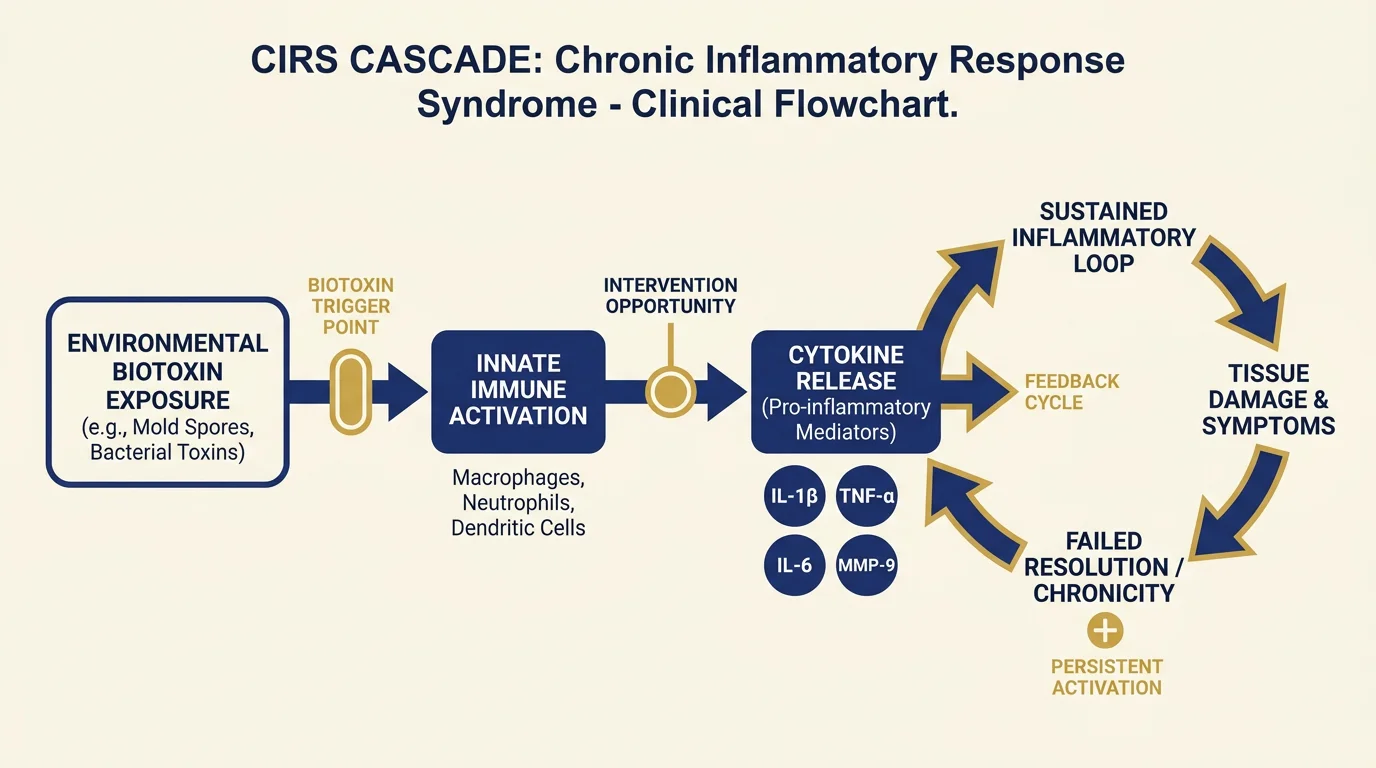
Mould illness, and its more severe form, chronic inflammatory response syndrome or CIRS, is one of the most under-recognised drivers of chronic illness. For a susceptible person, exposure to a water-damaged building sets off a sustained inflammatory response that does not switch off, even long after they leave the room. It is real, it is measurable, and it is treatable, but only once the exposure is found and removed.
Why mould makes some people so sick
Water-damaged buildings produce more than mould spores. They generate mycotoxins, bacterial fragments and other inflammatory compounds, and a susceptible person who breathes them in mounts an innate immune response that fails to resolve 1. In most people the body tags these toxins and clears them. In genetically susceptible people, often identified by certain HLA immune-gene types, the body cannot tag and clear them efficiently, so the toxins recirculate and the inflammation becomes chronic and self-sustaining. This is the difference between two people in the same mouldy house where one is fine and the other becomes severely ill, it is not the dose, it is the capacity to clear it 2.
The result is a multi-system illness. Fatigue, cognitive problems, mood changes, sensitivities, and a characteristic pattern of inflammatory markers, alongside biotoxins that should not be there. It looks like many other conditions, which is exactly why it is so often missed 6.
A real case
Rachel had a severe, multi-system illness that had resisted everything. Her testing told the real story. She had elevated mycotoxins, Ochratoxin A and Gliotoxin, biotoxins from mould 3. She had a positive MARCoNS nasal culture, an antibiotic-resistant organism that colonises in these cases and sustains the inflammation. Her inflammatory markers, C4a, TGF-beta1 and MMP-9, were all elevated 4, and her visual contrast sensitivity, a marker of biotoxin effect on the nervous system, had failed. She had the HLA susceptibility that meant her body could not clear the toxins on its own.
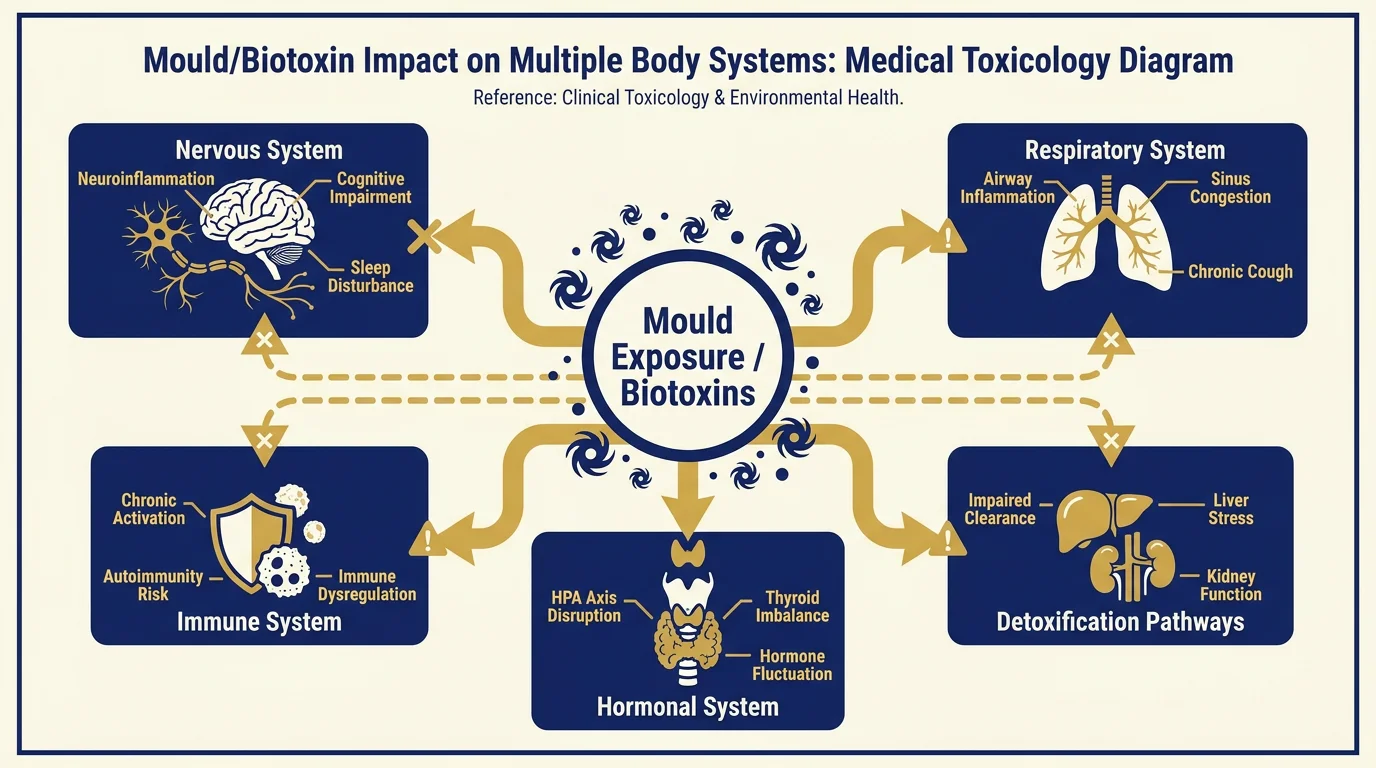
The crucial point is that no internal protocol would have resolved this while she was still being exposed. Recovery began with finding and removing the source, environmental remediation, and only then the medical sequence: clearing the biotoxins, eradicating the MARCoNS, calming the inflammation and restoring her detoxification, following the established CIRS protocol. It was not fast. At fourteen months her mycotoxins had cleared, MARCoNS was gone, her inflammatory markers had normalised, her visual contrast test passed, her brain fog lifted, her energy returned, and after eight months without one, her period came back. She could enter normal buildings again without relapsing. Mould had not been a life sentence. It had been a capacity problem, and once the load was removed, her body remembered how to heal.
Why this is so often missed
Mould illness is missed because the symptoms are non-specific and overlap with chronic fatigue, anxiety, autoimmune conditions and more, and because the testing that reveals it, mycotoxins, the CIRS inflammatory markers, nasal culture, visual contrast, is rarely run in standard care 5. The most important question, and the one almost never asked, is about your environment. Ask about your home. Ask about your workplace. Ask about any history of water damage, leaks or flooding. The answer to a years-long illness may not be inside your body at all. It may be in the building you return to every night. You cannot heal in a toxic environment, but once the environment is clean, the body knows what to do.
Where to start
How mould illness develops, how it is tested, and the recovery sequence are in my book.
For complex mould and CIRS cases, I take a small number of telehealth patients each year, across Australia and worldwide.
FAQ
What is CIRS?
Why do some people get sick from mould and others don't?
How do you test for mould illness?
Can you recover from mould illness?
I've tried everything and nothing works. Could it be mould?
References
- 1 A review of the mechanism of injury and treatment approaches for illness resulting from exposure to water-damaged buildings, mold, and mycotoxins. ScientificWorldJournal. 2013. view source
- 2 McEwen BS. Stress, adaptation, and disease: allostasis and allostatic overload. Ann N Y Acad Sci. 1998;840:33-44. view source
- 3 A review of the mechanism of injury and treatment approaches for illness resulting from exposure to water-damaged buildings, mold, and mycotoxins. ScientificWorldJournal. 2013. view source
- 4 A review of the mechanism of injury and treatment approaches for illness resulting from exposure to water-damaged buildings, mold, and mycotoxins. ScientificWorldJournal. 2013. view source
- 5 A review of the mechanism of injury and treatment approaches for illness resulting from exposure to water-damaged buildings, mold, and mycotoxins. ScientificWorldJournal. 2013. view source
- 6 McEwen BS. Stress, adaptation, and disease: allostasis and allostatic overload. Ann N Y Acad Sci. 1998;840:33-44. view source